An epiphany not unlike my last one ("God is better than humans!").
From WilburBlog, a quote from Robert Capon's Bed and Board:
“The reason the headship of the husband is so violently objected to is that it is misunderstood…the Bible does not say that men and women are unequal. Neither does the Church. There are no second-class citizens in the New Jerusalem. It is husbands and wives that are unequal. It is precisely in marriage…that they enter into a relationship of superior to inferior—of head to body. And the difference there is not one of worth, ability or intelligence, but of role. It is functional, not organic. It is based on the exigencies of the Dance, not on a judgment as to talent. In the ballet, in any intricate dance, one dancer leads, the other follows. Not because one is better (he may or may not be), but because that is his part. Our mistake, here as elsewhere, is to think the equality and diversity are unreconcilable. The common notion of equality is based on the image of the march. In a parade, really unequal beings are dressed alike, given guns of identical length, trained to hold them at the same angle, and ordered to keep step with a fixed beat. But it is not the parade that is true to life; it is the dance. There you have real equals assigned unequal roles in order that each may achieve his individual perfection in the whole. Nothing is less personal than a parade; nothing more so than a dance. It is the choice image of fulfillment through function, and it comes very close to the heart of the Trinity. Marriage is a hierarchical game played by co-equal persons. Keep that paradox and you move in the freedom of the Dance; alter it, and you grow weary with marching (53-54).”
21 June, 2007


20 June, 2007
I am not thirsty.
What with Kombucha, Kefir, raw milk, and fresh tomato juice, not to mention water...I've never had so much to drink in my life!
_____
So, the PCA GA made their decision to approve the FV/NPP report. Reformed News has this summary of the effects:
"The Assembly's adoption of the recommendations has the following effects: 1. The assembly commends the committee's report to the PCA for consideration, 2. The assembly reminds the PCA of the role of the Westminster Standards "as standard expositions of the teachings of Scripture in relation to both faith and practice", 3. The assembly commends the 9 declarations of the report to the denomination as "a faithful exposition of the Westminster Standards" and calls upon ruling and teaching elders to inform "their courts" (i.e., sessions, presbyteries) of any differences between their views and the 9 declarations, 4. The assembly reminds Sessions and Presbyteries of its duty to exercise doctrinal oversight, and 5. The assembly dismisses the study committee with thanks. ...
"Two questions confront Presbyteries as they examine elders who are either accused of holding suspect views or elders who submit their views to Presbyteries for consideration: a. do their views in fact fall under one of nine disallowed views, and b. if so, will their views be considered allowable exceptions or become grounds for further discipline. Currently the PCA does not have uniformity with regards to what exceptions are allowable or disallowable by every presbytery."
Has anyone heard anything else?
_____
So, the PCA GA made their decision to approve the FV/NPP report. Reformed News has this summary of the effects:
"The Assembly's adoption of the recommendations has the following effects: 1. The assembly commends the committee's report to the PCA for consideration, 2. The assembly reminds the PCA of the role of the Westminster Standards "as standard expositions of the teachings of Scripture in relation to both faith and practice", 3. The assembly commends the 9 declarations of the report to the denomination as "a faithful exposition of the Westminster Standards" and calls upon ruling and teaching elders to inform "their courts" (i.e., sessions, presbyteries) of any differences between their views and the 9 declarations, 4. The assembly reminds Sessions and Presbyteries of its duty to exercise doctrinal oversight, and 5. The assembly dismisses the study committee with thanks. ...
"Two questions confront Presbyteries as they examine elders who are either accused of holding suspect views or elders who submit their views to Presbyteries for consideration: a. do their views in fact fall under one of nine disallowed views, and b. if so, will their views be considered allowable exceptions or become grounds for further discipline. Currently the PCA does not have uniformity with regards to what exceptions are allowable or disallowable by every presbytery."
Has anyone heard anything else?
18 June, 2007
I am now the proud owner of...
a Kombucha mother! I felt it appropriate to name her, since she is the Mother of my Kombucha tea. I have named her Eve-- it seemed the best fit. Kombucha is almost like very mild tasting, slightly carbonated apple cider vinegar. That's really the best description I can give. You should try it for yourselves! It warms you right up.
I also have been given some Kefir (keh-FEER) grains with which to make cultured milk! It is tasty, and it takes less time than Kombucha. I had some Kefir of my own making this morning. It is deliciously tangy and resembles very liquid yoghurt.
Fermented beverages...they're more tasty than you might think!
I also have been given some Kefir (keh-FEER) grains with which to make cultured milk! It is tasty, and it takes less time than Kombucha. I had some Kefir of my own making this morning. It is deliciously tangy and resembles very liquid yoghurt.
Fermented beverages...they're more tasty than you might think!
11 June, 2007
Miscellany
Sorry for the lack of posting; our poor computer died, and I had to wait for Dad to fix it.
I've got a couple of jobs lined up for August: house-cleaning (part-time, $30/hour) and teaching (part-time, $9/hour). I'll have those two for the school year, at least. I'm hoping to save up for my first year's total expenses at college. I e-mailed NSA a while back and they never responded-- I did manage to e-mail at the busiest time of year, though. I'm going to call them later this week, and get more information about scholarships and such things.
I stopped by Borders today and read Leepike Ridge, Nathan Wilson's newest book. It was an excellent story. If you don't have it yet, I highly recommend buying it. Or you could do what this poor girl does, and read it in the bookstore!
______
"Beer, if drank with moderation, softens the temper, cheers the spirit and promotes health."
Thomas Jefferson
I've got a couple of jobs lined up for August: house-cleaning (part-time, $30/hour) and teaching (part-time, $9/hour). I'll have those two for the school year, at least. I'm hoping to save up for my first year's total expenses at college. I e-mailed NSA a while back and they never responded-- I did manage to e-mail at the busiest time of year, though. I'm going to call them later this week, and get more information about scholarships and such things.
I stopped by Borders today and read Leepike Ridge, Nathan Wilson's newest book. It was an excellent story. If you don't have it yet, I highly recommend buying it. Or you could do what this poor girl does, and read it in the bookstore!
______
"Beer, if drank with moderation, softens the temper, cheers the spirit and promotes health."
Thomas Jefferson
01 June, 2007
Andrew Lang
Andrew Lang, author of the many-coloured Fairy Books, also wrote poetry. Here is one of my favourites:
The Odyssey
AS one that for a weary space has lain
Lull'd by the song of Circe and her wine
In gardens near the pale of Proserpine,
Where that Ææan isle forgets the main,
And only the low lutes of love complain,
And only shadows of wan lovers pine—
As such an one were glad to know the brine
Salt on his lips, and the large air again—
So gladly from the songs of modern speech
Men turn, and see the stars, and feel the free
Shrill wind beyond the close of heavy flowers,
And through the music of the languid hours
They hear like Ocean on a western beach
The surge and thunder of the Odyssey.
_____________
He wrote letters to dead authors as well. Here's one of interest: a letter to Jane Austen.
The Odyssey
AS one that for a weary space has lain
Lull'd by the song of Circe and her wine
In gardens near the pale of Proserpine,
Where that Ææan isle forgets the main,
And only the low lutes of love complain,
And only shadows of wan lovers pine—
As such an one were glad to know the brine
Salt on his lips, and the large air again—
So gladly from the songs of modern speech
Men turn, and see the stars, and feel the free
Shrill wind beyond the close of heavy flowers,
And through the music of the languid hours
They hear like Ocean on a western beach
The surge and thunder of the Odyssey.
_____________
He wrote letters to dead authors as well. Here's one of interest: a letter to Jane Austen.
28 May, 2007
It must be the Scots-Irish in me.
I had the strangest dream last night: a villian held one of my first-graders hostage; he was going to kill her. So I shot him in the head. I told her I loved her, and then I shot him.
Chesterton again.
What can they mean when they say that we must not put militarism into boys? Can we by any possibility get militarism out of boys? You might burn it out with red-hot irons; you might eventually scourge it out as if it were a mediaeval devil; but except you employ the most poignant form of actual persecution, you certainly will not prevent little boys thinking about soldiers, talking about soldiers, and pretending that they are soldiers. You may mortify and macerate this feeling in them if you like, just as you may mortify and macerate their love of comrades, or their love of wandering…
A child’s instinct is almost perfect in the matter of fighting; a child always stands for the good militarism as against the bad. The child’s hero is always the man or boy who defends himself suddenly and splendidly against aggression. The child’s hero is never the man or boy who attempts by his mere personal force to extend his mere personal influence… To put the matter shortly, the boy feels an abysmal difference between conquest and victory. Conquest has the sound of something cold and heavy; the automatic operations of a powerful army. Victory has the sound of something sudden and valiant; victory is like a cry out of a living mouth. The child is excited with victory; he is bored with conquest. The child is not an Imperialist; the child is a Jingo – which is excellent. The child is not a militarist in the heavy, mechanical modern sense; the child is a fighter. Only very old and very wicked people can be militarists in the modern sense. Only very old and very wicked people can be peace-at-any-price men. The child’s instincts are quite clean and chivalrous, though perhaps a little exaggerated.
But really to talk of this small human creature, who never picks up an umbrella without trying to use it as a sword, who will hardly read a book in which there is no fighting, who out of the Bible itself generally remembers the ‘bluggy’ parts, who never walks down the garden without imagining himself to be stuck all over with swords and daggers – to take this human creature and talk about the wickedness of teaching him to be military, seems rather a wild piece of humour. He has already not only the tradition of fighting, but a far manlier and more genial tradition of fighting than our own. No; I am not in favour of the child being taught militarism. I am in favour of the child teaching it.
- The Illustrated London News, 20 October 1906.
Thanks to The Hebdomadal Chesterton for the extended quotations.
A child’s instinct is almost perfect in the matter of fighting; a child always stands for the good militarism as against the bad. The child’s hero is always the man or boy who defends himself suddenly and splendidly against aggression. The child’s hero is never the man or boy who attempts by his mere personal force to extend his mere personal influence… To put the matter shortly, the boy feels an abysmal difference between conquest and victory. Conquest has the sound of something cold and heavy; the automatic operations of a powerful army. Victory has the sound of something sudden and valiant; victory is like a cry out of a living mouth. The child is excited with victory; he is bored with conquest. The child is not an Imperialist; the child is a Jingo – which is excellent. The child is not a militarist in the heavy, mechanical modern sense; the child is a fighter. Only very old and very wicked people can be militarists in the modern sense. Only very old and very wicked people can be peace-at-any-price men. The child’s instincts are quite clean and chivalrous, though perhaps a little exaggerated.
But really to talk of this small human creature, who never picks up an umbrella without trying to use it as a sword, who will hardly read a book in which there is no fighting, who out of the Bible itself generally remembers the ‘bluggy’ parts, who never walks down the garden without imagining himself to be stuck all over with swords and daggers – to take this human creature and talk about the wickedness of teaching him to be military, seems rather a wild piece of humour. He has already not only the tradition of fighting, but a far manlier and more genial tradition of fighting than our own. No; I am not in favour of the child being taught militarism. I am in favour of the child teaching it.
- The Illustrated London News, 20 October 1906.
Thanks to The Hebdomadal Chesterton for the extended quotations.
19 May, 2007
G.K. Chesterton, of course:
I opened a paper only ten minutes ago in which it was solemnly said, in the fine old style of such arguments, that there was a time when men regarded women as chattels. This is outside the serious possibilities of the human race. Men never could have regarded women as chattels. If a man tried to regard a woman as a chattel his life would not be worth living for twenty-four hours. You might as well say that there was a bad custom of using live tigers as arm-chairs; or that men had outgrown the habit of wearing dangerous snakes instead of watch-chains. It may or may not be the fact that men have sometimes found it necessary to define the non-political position of women by some legal form which called them chattels; just as they have thought it necessary in England to define the necessary authority of the State by the legal form of saying that the King could do no wrong. Whether this is so or not I do not know, and I do not care. But that any living man ever felt like that, that any living man ever felt as if a woman was a piece of furniture, with which he could do what he liked, is starkly incredible. And the whole tradition and the whole literature of mankind is solid against it. There is any amount of literature from the earliest time in praise of woman: calling her a mother, a protectress, a goddess. There is any amount of literature from the earliest time devoted to the abuse of woman, calling her a serpent, a snare, a devil, a consuming fire. But there is no ancient literature whatever, from the Ionians to the Ashantees, which denies her vitality and her power. The woman is always either the cause of a wicked war, like Helen, or she is the end of a great journey, like Penelope. In all the enormous love poetry of the world, it is practically impossible to find more than two or three poems written by a man to a woman which adopt that tone of de haut en bas, that tone as towards a pet animal, which we are now constantly assured has been the historic tone of men towards women. The poems are all on the other note; it is always “Why is the queen so cruel?” “Why is the goddess so cold?”
- The Illustrated London News, 6 April 1907.
- The Illustrated London News, 6 April 1907.
28 March, 2007
27 March, 2007
New St. Andrew's College
Right, here's the deal. I have wanted to attend NSA for years. Yes, really. Miss No-I-won't-go-to-college-and-you-can't-make-me has kept this hidden and is now sheepishly bringing it out into the open. The desire is too great. My parents are still urging independence. And I'm not in danger of getting married any time soon (not from what I can see, anyway). What to do?
I post this is because I know you all will tell me exactly what you think. I've said over and over again, repetitively and redundantly, that I don't want to leave my family if it's possible for me to stay. They, however, are getting closer and closer to pushing me out of the nest. Can I, in good conscience, move to Idaho to go to college when they finally do the deed? Would I even have the money to go to school? Could I withstand the rigours of NSA?
My parents want me to go to college- they always have. I have consistently said no. Can I finally do what they want only because I want to do it too? That seems a silly question.
Advise me, O Counsellours. I need help to think this through.
I post this is because I know you all will tell me exactly what you think. I've said over and over again, repetitively and redundantly, that I don't want to leave my family if it's possible for me to stay. They, however, are getting closer and closer to pushing me out of the nest. Can I, in good conscience, move to Idaho to go to college when they finally do the deed? Would I even have the money to go to school? Could I withstand the rigours of NSA?
My parents want me to go to college- they always have. I have consistently said no. Can I finally do what they want only because I want to do it too? That seems a silly question.
Advise me, O Counsellours. I need help to think this through.
20 March, 2007
Spring Break
I have made a huge mistake.
I've been reading Fast Food Nation in my free time this week, and it is disgusting. After learning a few things about the modern-day cattle business, I now feel completely justified in not liking ground beef and in refusing to eat at fast food restaurants. However, I'm also having trouble wanting to eat any meat now...this makes things difficult. Do I eat the nasty meat, origins unknown? Or do I go hungry? Obviously, I cannot go hungry. The alternative to the scary meat is expensive, though. So I've decided: whoever's gonna marry me had better do it quick, so we can get that farm going.
In the meantime, here's a neat website that I've been looking at: www.eatwild.com. They have state-by state lists of grass-fed, anti-antibiotic, hormone-free meat suppliers.
Also, Fast Food Nation has a story in it about a Frenchman named José Bové who ran his tractor into a McDonald's. He also came up with this great slogan : "Non à McMerde!" which (if one wishes to be less offensive) roughly translates to "No to McPoo!". There's another story about a couple of friends who were sued for libel by McDonald's and managed to drag out the trial eleven years and drag McDonald's through the mud while they were at it. You can read about that by googling Helen Steel, Dave Morris, and McLibel. It's a great story.
I've been reading Fast Food Nation in my free time this week, and it is disgusting. After learning a few things about the modern-day cattle business, I now feel completely justified in not liking ground beef and in refusing to eat at fast food restaurants. However, I'm also having trouble wanting to eat any meat now...this makes things difficult. Do I eat the nasty meat, origins unknown? Or do I go hungry? Obviously, I cannot go hungry. The alternative to the scary meat is expensive, though. So I've decided: whoever's gonna marry me had better do it quick, so we can get that farm going.
In the meantime, here's a neat website that I've been looking at: www.eatwild.com. They have state-by state lists of grass-fed, anti-antibiotic, hormone-free meat suppliers.
Also, Fast Food Nation has a story in it about a Frenchman named José Bové who ran his tractor into a McDonald's. He also came up with this great slogan : "Non à McMerde!" which (if one wishes to be less offensive) roughly translates to "No to McPoo!". There's another story about a couple of friends who were sued for libel by McDonald's and managed to drag out the trial eleven years and drag McDonald's through the mud while they were at it. You can read about that by googling Helen Steel, Dave Morris, and McLibel. It's a great story.
06 March, 2007
St. Paul is not a psycho.
I like posting things written by others, especially when I'm busy. It's just so easy. I'm only a little sorry. I'll try to think of something "original" to post soon.
"Where is faith? In a faithful person, you might say. But where is faith, in that person? My gut tells me that for most, explicitly or implicitly, faith, as a fruit of the Spirit's work in man, is thought to be found in a person's brain. This is not surprising since it is relatively easy to manipulate the thoughts of your brain, but it is a mysterious mission (at best) to attempt to control the thoughts of your hands and legs. We, however reformed we claim to be, still want to have some power over God. It seems what is meant by a lot of folks saying, 'sola fide' is really 'faith alone in my brain.' And then it's no wonder that hearty affirmations of efficacious sacraments make them choke. And yet the work of the Spirit is in the whole man: renewing the mind throughout our bodies. If faith is only needed in our brains, St. Paul is psycho, for all his insistence on the subduing of our bodily members to Christ. Lastly, if we as the Church make up Christ's body, and our bodies will one day be made like his body, then this has to inform not only our ecclesiology and eschatology but our ontology and epistemology. There is more going on than our brains can tell us. Not only do we need faithful brains, but we need faithful eyes, faithful knee caps, and faithful finger nails. And that, my friend, is why it's important to dance."
Borrowed from someone named Toby Sumpter- unfortunately, I don't remember who that is.
"Where is faith? In a faithful person, you might say. But where is faith, in that person? My gut tells me that for most, explicitly or implicitly, faith, as a fruit of the Spirit's work in man, is thought to be found in a person's brain. This is not surprising since it is relatively easy to manipulate the thoughts of your brain, but it is a mysterious mission (at best) to attempt to control the thoughts of your hands and legs. We, however reformed we claim to be, still want to have some power over God. It seems what is meant by a lot of folks saying, 'sola fide' is really 'faith alone in my brain.' And then it's no wonder that hearty affirmations of efficacious sacraments make them choke. And yet the work of the Spirit is in the whole man: renewing the mind throughout our bodies. If faith is only needed in our brains, St. Paul is psycho, for all his insistence on the subduing of our bodily members to Christ. Lastly, if we as the Church make up Christ's body, and our bodies will one day be made like his body, then this has to inform not only our ecclesiology and eschatology but our ontology and epistemology. There is more going on than our brains can tell us. Not only do we need faithful brains, but we need faithful eyes, faithful knee caps, and faithful finger nails. And that, my friend, is why it's important to dance."
Borrowed from someone named Toby Sumpter- unfortunately, I don't remember who that is.
03 March, 2007
Another Winner from Sora Colvin
I've been catching up a bit on my blog-reading this morning, and I ran across a good post by Mrs. Colvin. On 17 February, she compared classical education and homeschooling. I have to say, I completely agree with her. She wrote several things that I've been thinking of lately, such as:
"...what is efficient for the teachers and administrators is terribly inefficient -- for the student."
and,
"Simply "managing" -- or, less charitably, "babysitting" -- a group of 20 seven year olds, keeping them attentive and on task as a group, takes a great part of the school day. "
I only have nine and it is extremely difficult to keep their attention. They all work at different paces, and they all want my attention in the same way. They also feed off of each other- one stops working and misbehaves, and the rest join right in. Of course they do! They're seven! Tell me again why we're running the school this way?
I can't wait to school my own children.
"...what is efficient for the teachers and administrators is terribly inefficient -- for the student."
and,
"Simply "managing" -- or, less charitably, "babysitting" -- a group of 20 seven year olds, keeping them attentive and on task as a group, takes a great part of the school day. "
I only have nine and it is extremely difficult to keep their attention. They all work at different paces, and they all want my attention in the same way. They also feed off of each other- one stops working and misbehaves, and the rest join right in. Of course they do! They're seven! Tell me again why we're running the school this way?
I can't wait to school my own children.
02 March, 2007
Sorry.
Scolded, I repent in dust and ashes.
For the curious, I am still teaching at what Lisa lovingly has termed "The School from Hell". I will not be returning next year. I have, however, tentatively agreed to homeschool three siblings next year. The two oldest are currently in my class. It will pay more, and by that I mean that I'll actually get to EAT the peanuts they poke through the fence.
In other news, we're having fun dancing every Friday night. A big group of us collegiate-types are learning (or relearning, in my case) the waltz and other fun ballrooms dances. For free!
Also, I got this great new book for Christmas (better late than never, eh?)! It's called Deep Comedy, and I am enjoying it quite a bit. Unfortunately, I haven't much time to read.
And for the deep-dark-corners-curious, I am being followed around by not one but two menfolk. One: maybe; the other: not so much. That's all I have to say about that.
For the curious, I am still teaching at what Lisa lovingly has termed "The School from Hell". I will not be returning next year. I have, however, tentatively agreed to homeschool three siblings next year. The two oldest are currently in my class. It will pay more, and by that I mean that I'll actually get to EAT the peanuts they poke through the fence.
In other news, we're having fun dancing every Friday night. A big group of us collegiate-types are learning (or relearning, in my case) the waltz and other fun ballrooms dances. For free!
Also, I got this great new book for Christmas (better late than never, eh?)! It's called Deep Comedy, and I am enjoying it quite a bit. Unfortunately, I haven't much time to read.
And for the deep-dark-corners-curious, I am being followed around by not one but two menfolk. One: maybe; the other: not so much. That's all I have to say about that.
20 January, 2007
What, again?
Yes, it's true. It's Snowing!
What has happened to our weather? Are we stealing Snow from some northern state? It's like a miracle- Snow three times in one winter! It's actually Winter! I can't stop using exclamation points! That's how weird this is! And how excited I am! Yay!
In honor of Snow, I present to you...
Five Things I love that are white:
1. SNOW. Of course!
2. Yoghurt. Best late-night (read: ten o'clock) snack ever.
3. Paper- to read of off, to write on, and to cut into clever shapes.
4. Milk. We found someone who has cows. :)
5. Clean sheets that are cold when you first lie down but are so warm in the morning that you don't want to move.
Enough silliness for one night. I'm going to bed- church tomorrow!
What has happened to our weather? Are we stealing Snow from some northern state? It's like a miracle- Snow three times in one winter! It's actually Winter! I can't stop using exclamation points! That's how weird this is! And how excited I am! Yay!
In honor of Snow, I present to you...
Five Things I love that are white:
1. SNOW. Of course!
2. Yoghurt. Best late-night (read: ten o'clock) snack ever.
3. Paper- to read of off, to write on, and to cut into clever shapes.
4. Milk. We found someone who has cows. :)
5. Clean sheets that are cold when you first lie down but are so warm in the morning that you don't want to move.
Enough silliness for one night. I'm going to bed- church tomorrow!
19 January, 2007
This is ridiculous.
School's been closed since Friday last and won't open again until Monday. It's just a little snow!
No really, the school parking lot, which is horrible to begin with, is a sheet of ice. Hopefully it's melted by now, but it's supposed to snow again tomorrow, so there's no telling.
That's a whole week that the kids have had to forget their spelling words. That is not good. Monday shall be quite interesting.
No really, the school parking lot, which is horrible to begin with, is a sheet of ice. Hopefully it's melted by now, but it's supposed to snow again tomorrow, so there's no telling.
That's a whole week that the kids have had to forget their spelling words. That is not good. Monday shall be quite interesting.
14 January, 2007
It's snowing!
They cancelled church! Isn't that odd? School was out Friday and will be out tomorrow, too. Meanwhile, I'm drinking coffee and cutting out snowflakes. A happy occupation.
I realised something today. My parents used to tell me that a man wanted a clever wife who could carry on an intelligent conversation. They haven't said that in a while. I was wondering if that means I should stop reading and keep my mouth shut now? I shouldn't want to be too clever and monopolise the conversation.
Anyway, it was a funny thought. It reminds me of their story about my beginning to talk- evidently they thought I would never start, and then when I did, they thought I would never stop!
I realised something today. My parents used to tell me that a man wanted a clever wife who could carry on an intelligent conversation. They haven't said that in a while. I was wondering if that means I should stop reading and keep my mouth shut now? I shouldn't want to be too clever and monopolise the conversation.
Anyway, it was a funny thought. It reminds me of their story about my beginning to talk- evidently they thought I would never start, and then when I did, they thought I would never stop!
13 January, 2007
"Why Contemporary Reformed Theological Debate Makes Me Want to Vomit"
Getting in touch with my catholic side.
Because evidently, I am a heretic and not a member of Christ's Church. Please pray for me.
I have a headache. I'm going to go apply a salve: Rev. Wilson's biography of John Knox ought to do nicely.
Because evidently, I am a heretic and not a member of Christ's Church. Please pray for me.
I have a headache. I'm going to go apply a salve: Rev. Wilson's biography of John Knox ought to do nicely.
05 January, 2007
Epiphanies
I'm sad to have missed the rest of the days of Christmas, but I've been a little busy. So, now that I have a moment, I'll just let you all in on a few things I've learned in the past three days of teaching first and second grade.
1. I hate Abeka curriculum with a passion.
2. Evidently, I can't tell the difference between a long vowel and a short vowel.
3. I forgot. That's what happens when all you've been saying all day consists of these six phrases (or variants of the same):
-Sit down.
-Stop talking.
-Obey me the first time.
-Meg! Stop!
-Do your work.
-Turn around and sit correctly in your chair.
I now understand (actually understand) why homeschooling the Veritas/Abeka way is ridiculous in the extreme. Why would you want to try to teach that many subjects at once, with that much material in each one? Give me a break!
1. I hate Abeka curriculum with a passion.
2. Evidently, I can't tell the difference between a long vowel and a short vowel.
3. I forgot. That's what happens when all you've been saying all day consists of these six phrases (or variants of the same):
-Sit down.
-Stop talking.
-Obey me the first time.
-Meg! Stop!
-Do your work.
-Turn around and sit correctly in your chair.
I now understand (actually understand) why homeschooling the Veritas/Abeka way is ridiculous in the extreme. Why would you want to try to teach that many subjects at once, with that much material in each one? Give me a break!
28 December, 2006
On the fourth day of Christmas my True Love gave to me...
The beginning of the gospel of Jesus Christ, the Son of God.
As it is written in Isaiah the prophet,
"Behold, I send my messenger before your face,
who will prepare your way,
the voice of one crying in the wilderness:
'Prepare the way of the Lord,
make His paths straight,'"
John appeared, baptising in the wilderness and proclaiming a baptism of repentance for the forgiveness of sins. And all the country of Judea and all Jerusalem were going out to him and were being baptised by him in the river Jordan, confessing their sins. Now John was clothed with camel's hair and wore a leather belt around his waist and ate locusts and wild honey. And he preached, saying, "After me comes he who is mightier than I, the strap of whose sandals I am not worthy to stoop down and untie. I have baptised you with water, but he will baptise you with the Holy Spirit."
Mark 1:1-8
And Mary said,
"My soul magnifies the Lord,
and my spirit rejoices in God my Savior,
for He has looked on the humble estate of His servant.
For behold, from now on all generations will call me blessed;
for He who is mighty has done great things for me,
and holy is His name.
And His mercy is for those who fear Him
from generation to generation.
He has shown strength with His arm;
He has scattered the proud in the thoughts of their hearts;
He has brought down the mighty from their thrones
and exalted those of humble estate;
He has filled the hungry with good things,
and the rich He has sent empty away.
He has helped His servant Israel,
in remembrance of His mercy,
as He spoke to our fathers,
to Abraham and to his offspring forever."
Luke 1:46-55
Now the birth of Jesus Christ took place in this way. When his mother Mary had been betrothed to Joseph, before they came together she was found to be with child from the Holy Spirit. And her husband Joseph, being a just man and unwilling to put her to shame, resolved to divorce her quietly. But as he considered these things, behold, an angel of the Lord appeared to him in a dream, saying, "Joseph, son of David, do not fear to take Mary as your wife, for that which is conceived in her is from the Holy Spirit. She will bear a son, and you shall call his name Jesus, for he will save his people from their sins."
All this took place to fulfill what the Lord had spoken by the prophet:
"Behold, the virgin shall conceive and bear a son,and they shall call his name Immanuel"
(which means, God with us). When Joseph woke from sleep, he did as the angel of the Lord commanded him: he took his wife, but knew her not until she had given birth to a son. And he called his name Jesus.
Matthew 1:18-25
In the beginning was the Word, and the Word was with God, and the Word was God. He was in the beginning with God. All things were made through Him, and without Him was not any thing made that was made. In Him was life, and the life was the light of men. The light shines in the darkness, and the darkness has not overcome it.
And the Word became flesh and dwelt among us, and we have seen His glory, glory as of the only Son from the Father, full of grace and truth.
John 1:1-5, 14
As it is written in Isaiah the prophet,
"Behold, I send my messenger before your face,
who will prepare your way,
the voice of one crying in the wilderness:
'Prepare the way of the Lord,
make His paths straight,'"
John appeared, baptising in the wilderness and proclaiming a baptism of repentance for the forgiveness of sins. And all the country of Judea and all Jerusalem were going out to him and were being baptised by him in the river Jordan, confessing their sins. Now John was clothed with camel's hair and wore a leather belt around his waist and ate locusts and wild honey. And he preached, saying, "After me comes he who is mightier than I, the strap of whose sandals I am not worthy to stoop down and untie. I have baptised you with water, but he will baptise you with the Holy Spirit."
Mark 1:1-8
And Mary said,
"My soul magnifies the Lord,
and my spirit rejoices in God my Savior,
for He has looked on the humble estate of His servant.
For behold, from now on all generations will call me blessed;
for He who is mighty has done great things for me,
and holy is His name.
And His mercy is for those who fear Him
from generation to generation.
He has shown strength with His arm;
He has scattered the proud in the thoughts of their hearts;
He has brought down the mighty from their thrones
and exalted those of humble estate;
He has filled the hungry with good things,
and the rich He has sent empty away.
He has helped His servant Israel,
in remembrance of His mercy,
as He spoke to our fathers,
to Abraham and to his offspring forever."
Luke 1:46-55
Now the birth of Jesus Christ took place in this way. When his mother Mary had been betrothed to Joseph, before they came together she was found to be with child from the Holy Spirit. And her husband Joseph, being a just man and unwilling to put her to shame, resolved to divorce her quietly. But as he considered these things, behold, an angel of the Lord appeared to him in a dream, saying, "Joseph, son of David, do not fear to take Mary as your wife, for that which is conceived in her is from the Holy Spirit. She will bear a son, and you shall call his name Jesus, for he will save his people from their sins."
All this took place to fulfill what the Lord had spoken by the prophet:
"Behold, the virgin shall conceive and bear a son,and they shall call his name Immanuel"
(which means, God with us). When Joseph woke from sleep, he did as the angel of the Lord commanded him: he took his wife, but knew her not until she had given birth to a son. And he called his name Jesus.
Matthew 1:18-25
In the beginning was the Word, and the Word was with God, and the Word was God. He was in the beginning with God. All things were made through Him, and without Him was not any thing made that was made. In Him was life, and the life was the light of men. The light shines in the darkness, and the darkness has not overcome it.
And the Word became flesh and dwelt among us, and we have seen His glory, glory as of the only Son from the Father, full of grace and truth.
John 1:1-5, 14
On the third day of Christmas my True Love gave to me...
But when the goodness and loving-kindness of God our Saviour appeared, He saved us, not because of works done by us in righteousness, but according to His own mercy, by the washing of regeneration and renewal of the Holy Spirit, Whom He poured out on us richly through Jesus Christ our Saviour, so that being justified by His grace we might become heirs according to the hope of eternal life.
Titus 3:4-7
Titus 3:4-7
26 December, 2006
On the second day of Christmas my True Love gave to me...
Comfort, comfort my people, says your God.
Speak tenderly to Jerusalem,
and cry to her
that her warfare is ended,
that her iniquity is pardoned,
that she has received from the LORD's hand
double for all her sins.
The voice of one crying in the wilderness:
'Prepare the way of the Lord,
make his paths straight.
Every valley shall be filled,
and every mountain and hill shall be made low,
and the crooked shall become straight,
and the rough places shall become level ways,
and all flesh shall see the salvation of God.'
Isaiah 40:1-2 and Luke 3:4b-6
Speak tenderly to Jerusalem,
and cry to her
that her warfare is ended,
that her iniquity is pardoned,
that she has received from the LORD's hand
double for all her sins.
The voice of one crying in the wilderness:
'Prepare the way of the Lord,
make his paths straight.
Every valley shall be filled,
and every mountain and hill shall be made low,
and the crooked shall become straight,
and the rough places shall become level ways,
and all flesh shall see the salvation of God.'
Isaiah 40:1-2 and Luke 3:4b-6
On the first day of Christmas my True Love gave to me...
The people who walked in darkness have seen a great light; those who dwelt in a land of deep darkness, on them has light shined. You have multiplied the nation; you have increased its joy; they rejoice before you as with joy at the harvest, as they are glad when they divide the spoil. For the yoke of his burden, and the staff for his shoulder, the rod of his oppressor, you have broken as on the day of Midian.
For to us a child is born, to us a son is given; and the government shall be upon his shoulder, and his name shall be called Wonderful Counselor, Mighty God, Everlasting Father, Prince of Peace. Of the increase of his government and of peace there will be no end, on the throne of David and over his kingdom, to establish it and to uphold it with justice and with righteousness from this time forth and forevermore. The zeal of the LORD of hosts will do this.
Isaiah 9:2-4, 6-7
On gratitude, from http://havingtwolegs.blogspot.com/ , posted on Monday, 18 December, year of our Lord 2006:
"This table is the Eucharist, the table of thanksgiving....You may not go around acting like you eat at the table of bitterness and ingratitude. Remember your allegiance to Jesus. He is King. You are his people. Therefore be loyal subjects to the King. Come eat, drink, and rejoice and again I say, rejoice!"
For to us a child is born, to us a son is given; and the government shall be upon his shoulder, and his name shall be called Wonderful Counselor, Mighty God, Everlasting Father, Prince of Peace. Of the increase of his government and of peace there will be no end, on the throne of David and over his kingdom, to establish it and to uphold it with justice and with righteousness from this time forth and forevermore. The zeal of the LORD of hosts will do this.
Isaiah 9:2-4, 6-7
On gratitude, from http://havingtwolegs.blogspot.com/ , posted on Monday, 18 December, year of our Lord 2006:
"This table is the Eucharist, the table of thanksgiving....You may not go around acting like you eat at the table of bitterness and ingratitude. Remember your allegiance to Jesus. He is King. You are his people. Therefore be loyal subjects to the King. Come eat, drink, and rejoice and again I say, rejoice!"
25 December, 2006
Merry Christmas!
No more let sins and sorrows grow;
Nor thorns infest the ground.
He comes to make His blessings known
Far as the curse is found!
And the angel said unto them, Fear not: for, behold, I bring you good tidings of great joy, which shall be to all people. For unto you is born this day in the city of David a Saviour, which is Christ the Lord. And this shall be a sign unto you; Ye shall find the babe wrapped in swaddling clothes, lying in a manger.
And suddenly there was with the angel a multitude of the heavenly host praising God, and saying,
Glory to God in the highest, and on earth peace, good will toward men.
Luke 2: 10-14
Nor thorns infest the ground.
He comes to make His blessings known
Far as the curse is found!
And the angel said unto them, Fear not: for, behold, I bring you good tidings of great joy, which shall be to all people. For unto you is born this day in the city of David a Saviour, which is Christ the Lord. And this shall be a sign unto you; Ye shall find the babe wrapped in swaddling clothes, lying in a manger.
And suddenly there was with the angel a multitude of the heavenly host praising God, and saying,
Glory to God in the highest, and on earth peace, good will toward men.
Luke 2: 10-14
18 December, 2006
We now interrupt your regularly scheduled programme to bring you this report from Miss Puritan Chickie, coming to you live from the Saucy Chair.
Mischievousness: Book Titles Inspired by Sunday's Sermon
1. Why God Made Earthquakes: How I Came to Hate Dependence Upon Myself
2. Food For Thought: 101 Sermon Illustrations, including: "When I Was a Boy", "Mowing the Lawn", "When I Was in Seminary", "There Will Be a Test", "My Friend (insert name)", "Fishing Trip", "The Young Hippie", and so many more!
3. Church as Covenant Renewal or How I Began to Love High Liturgy and to Hate Three Songs and a Lecture
4. True Blessings: All Things Taken in Faith
5. How to Teach Your Congregation Through Football, Hockey, and Baseball Anecdotes
Examples inside!
_______
Special thanks to television, for giving me a short attention span in church and for the header from today's post.
1. Why God Made Earthquakes: How I Came to Hate Dependence Upon Myself
2. Food For Thought: 101 Sermon Illustrations, including: "When I Was a Boy", "Mowing the Lawn", "When I Was in Seminary", "There Will Be a Test", "My Friend (insert name)", "Fishing Trip", "The Young Hippie", and so many more!
3. Church as Covenant Renewal or How I Began to Love High Liturgy and to Hate Three Songs and a Lecture
4. True Blessings: All Things Taken in Faith
5. How to Teach Your Congregation Through Football, Hockey, and Baseball Anecdotes
Examples inside!
_______
Special thanks to television, for giving me a short attention span in church and for the header from today's post.
17 December, 2006
Two Things: Coffee and Chesterton
1. I received my first Christmas present this morning (a little early, but I don't mind!). It's a French Press Pot! And it came with two flavoured coffees-- pumpkin pie and chocolate. Decaffeinated, of course. Jessie gave it me, and I'm having fun figuring out how to use it to make the best coffee.
2. A quote from Chesterton's The Ball and The Cross:
"...Now, let us put the matter very plainly, and without any romantic nonsense about honour or anything of that sort. Is not bloodshed a great sin?"
"No," said MacIan, speaking for the first time.
"Well, really, really!" said the peacemaker.
"Murder is a sin," said the immovable Highlander. "There is no sin of bloodshed."
"Well, we won't quarrel about a word, " said the other, pleasantly.
"Why on earth not?" said MacIan, with a sudden asperity. "Why shouldn't we quarrel about a word? What is the good of words if they aren't important enough to quarrel over? Why do we choose one word more than another if there isn't any difference between them? If you called a woman a chimpanzee instead of an angel, wouldn't there be a quarrel about a word? If you're not going to argue about words, what are you going to argue about? Are you going to convey your meaning to me by moving your ears? The Church and the heresies always used to fight about words, because they are the only things worth fighting about. I say that murder is a sin, and bloodshed is not, and that there is as much difference between those words as there is between the word 'yes' and the word 'no'; or rather more difference, for 'yes' and 'no', at least, belong to the same category. Murder is a spiritual incident. Bloodshed is a physical incident. A surgeon commits bloodshed."
2. A quote from Chesterton's The Ball and The Cross:
"...Now, let us put the matter very plainly, and without any romantic nonsense about honour or anything of that sort. Is not bloodshed a great sin?"
"No," said MacIan, speaking for the first time.
"Well, really, really!" said the peacemaker.
"Murder is a sin," said the immovable Highlander. "There is no sin of bloodshed."
"Well, we won't quarrel about a word, " said the other, pleasantly.
"Why on earth not?" said MacIan, with a sudden asperity. "Why shouldn't we quarrel about a word? What is the good of words if they aren't important enough to quarrel over? Why do we choose one word more than another if there isn't any difference between them? If you called a woman a chimpanzee instead of an angel, wouldn't there be a quarrel about a word? If you're not going to argue about words, what are you going to argue about? Are you going to convey your meaning to me by moving your ears? The Church and the heresies always used to fight about words, because they are the only things worth fighting about. I say that murder is a sin, and bloodshed is not, and that there is as much difference between those words as there is between the word 'yes' and the word 'no'; or rather more difference, for 'yes' and 'no', at least, belong to the same category. Murder is a spiritual incident. Bloodshed is a physical incident. A surgeon commits bloodshed."
30 November, 2006
Recipe for Baked Apricot-Wild Rice Chicken
This recipe is one I discovered and then altered to make it my own. It's very tasty and homey.
This recipe makes six servings.
Place one whole chicken (or 1/2 chicken breast per person) in a roasting pan with one large onion and three cloves garlic, minced. Glaze with honey and the juice of one lemon. Sprinkle lightly with turmeric. Roast, covered, for one hour at 350*.
Remove chicken from roaster and measure out the juice. Add water or broth to make 3 to 3 1/2 cups. Pour 1 and 1/2 c. rice and liquid into pan. Add 1/2 c. apricots (dried, chopped), some rosemary, sage, celery seed, salt, and pepper. Place chicken on top of mixture. Cover and bake 35-45 minutes or until rice is tender. Stir 1/2 c. pecan halves into rice and serve.
*Rice:
I use a mixture of white and brown rice because the family isn't very keen on brown rice yet.
White rice: use 1/4 c. per person, and 1/2 c. liquid per person.
Brown rice: use 1/4 c. per person, and 1/2 c. liquid per person, but add another 1/2 to 3/4 cup liquid.
*I haven't used a whole chicken in this recipe yet, so I'm not certain of the times.
This recipe makes six servings.
Place one whole chicken (or 1/2 chicken breast per person) in a roasting pan with one large onion and three cloves garlic, minced. Glaze with honey and the juice of one lemon. Sprinkle lightly with turmeric. Roast, covered, for one hour at 350*.
Remove chicken from roaster and measure out the juice. Add water or broth to make 3 to 3 1/2 cups. Pour 1 and 1/2 c. rice and liquid into pan. Add 1/2 c. apricots (dried, chopped), some rosemary, sage, celery seed, salt, and pepper. Place chicken on top of mixture. Cover and bake 35-45 minutes or until rice is tender. Stir 1/2 c. pecan halves into rice and serve.
*Rice:
I use a mixture of white and brown rice because the family isn't very keen on brown rice yet.
White rice: use 1/4 c. per person, and 1/2 c. liquid per person.
Brown rice: use 1/4 c. per person, and 1/2 c. liquid per person, but add another 1/2 to 3/4 cup liquid.
*I haven't used a whole chicken in this recipe yet, so I'm not certain of the times.
28 November, 2006
Food!
 Since I've been cooking and baking so many new things recently, I thought I'd post some pictures and recipes of my (new) favourites. I've already posted the recipe for Georgian Khachapuri (the delicious cheesy bread), but there's nothing like a picture when you can't actually see something. Here's one from the batch I made Thanksgiving night for supper. That stuff you see coming out of the top is CHEESE, thanks be to God.
We threw a surprise chocolate party for A's birthday last Friday. What with chocolate pecan pie, Death by Chocolate Cake, truffles, Chocolate Peppermint Sticks, fudge, Dad's Chocolate Peanut Butter Chip Cookies, and chocolate coffee pudding, I think we're all going to be on a sugar high for weeks! Unfortunately, we ate most everything, and didn't take pictures before we fell to. Next time I make Death by Chocolate Cake or truffles (the best ones, in my opinion), I'll be sure to have my camera ready.
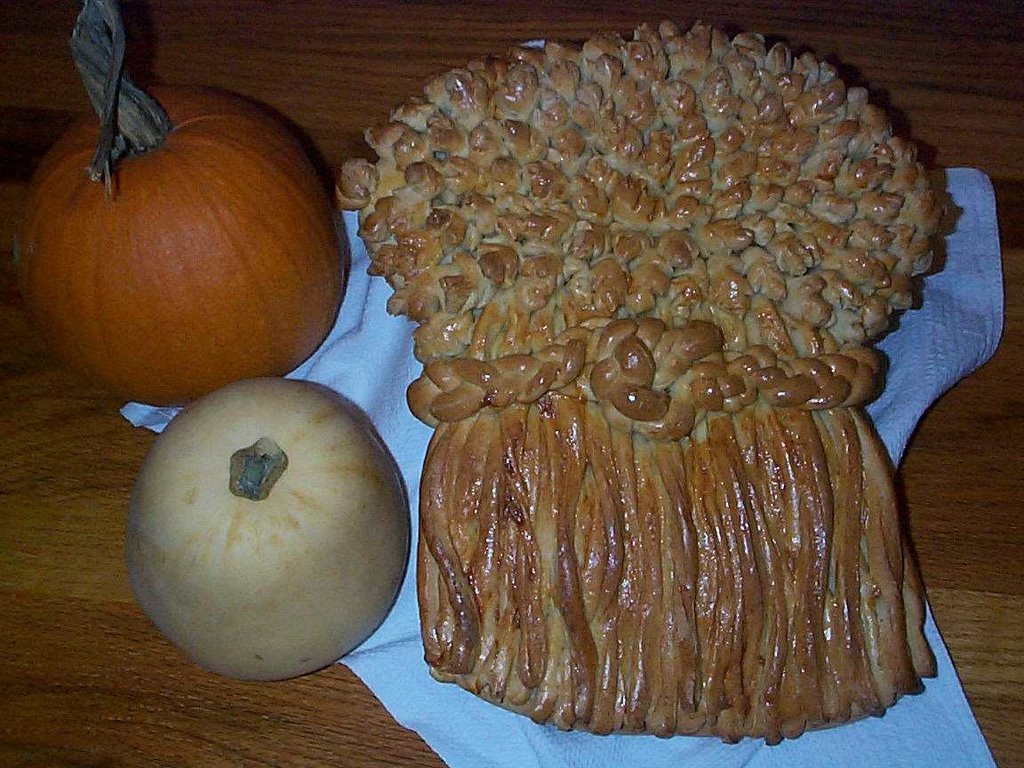 For Thanksgiving dinner, I made Baked Apricot-Wild Rice Chicken. We also had cranberry sauce, broccoli, and rolls, followed by pumpkin pie and chocolate cheesecake. The cheesecake was a big hit. I also made a centerpiece by baking bread in the shape of a shock of wheat.
Also this week, I've made Bouillebaisse, which is a new family favourite. It's a fish stew sort of dish and it's excellent with some crusty bread. I like to make baguettes to serve hot with supper. Sad thing, I don't actually like to eat the stew. Everyone else does, though, so I've added it to our list of meals.
Next week is our cookie exchange. I'll be getting some new recipes then, so I'll have plenty more baking to do! I'll be making my grandmother's now-famous molasses cookies. So tasty.
Recipes tomorrow!
21 November, 2006
A Miscellany of Men, G.K. Chesterton
...we are far too seldom reminded that just as church-going is not religion, so reading and writing are not knowledge, and voting is not self-government.
The notion of self-government was not (as many modern friends and foes of it seem to think) the notion that the ordinary citizen is to be consulted as one consults an encyclopedia. He is not there to be asked a lot of fancy questions, to see how he answers them. He and his fellows are to be, within reasonable human limits, masters of their own lives. They shall decide whether they shall be men of the oar or the wheel, of the spade or the spear. The men of the valley shall settle whether it shall be hoary with thatches or splendid with spires. ... And in case the word 'man' be misunderstood, I may remark that in this moral atmosphere, this original soul of self-government, the women always have quite as much influence as the men. But in modern England neither the men nor the women have any influence at all. In this primary matter, the moulding of the landscape, the creation of a mode of life, the people are utterly impotent.
[The local man] would be, I seriously believe, the best judge of whether farmsteads or factory chimneys should adorn his own sky-line, of whether stupid squires or clever usurers should govern his own village. But these are precisely the things which the oligarchs will not allow him to touch with his finger. Instead, they allow him an Imperial destiny and divine mission to alter, under their guidance, all the things that he knows nothing about.
Pages 6, 7, and 9
The notion of self-government was not (as many modern friends and foes of it seem to think) the notion that the ordinary citizen is to be consulted as one consults an encyclopedia. He is not there to be asked a lot of fancy questions, to see how he answers them. He and his fellows are to be, within reasonable human limits, masters of their own lives. They shall decide whether they shall be men of the oar or the wheel, of the spade or the spear. The men of the valley shall settle whether it shall be hoary with thatches or splendid with spires. ... And in case the word 'man' be misunderstood, I may remark that in this moral atmosphere, this original soul of self-government, the women always have quite as much influence as the men. But in modern England neither the men nor the women have any influence at all. In this primary matter, the moulding of the landscape, the creation of a mode of life, the people are utterly impotent.
[The local man] would be, I seriously believe, the best judge of whether farmsteads or factory chimneys should adorn his own sky-line, of whether stupid squires or clever usurers should govern his own village. But these are precisely the things which the oligarchs will not allow him to touch with his finger. Instead, they allow him an Imperial destiny and divine mission to alter, under their guidance, all the things that he knows nothing about.
Pages 6, 7, and 9
I've had an apostrophe...
Lightnin' has struck my brain.
This article was posted on the RUF list-serv (e-mail discussion forum). I was writing an e-mail to respond to it, and I realised, half-way through my second proof-read, that I have way too many commas in this sentence. That's not actually, what, I realised, I just, thought, that I, would write that, because, it was getting, ridic,ulous. Ahem. Sorry...Where was I? Oh, yes. I realised that I hate list-serv discussions. And now I know why, because I unconsciously wrote it out in my reply. Here's what I said (unedited):
"Before everyone jumps in and tears this author and his article to teeny-weeny pieces for any and every reason other than the legitimate one, that of disagreement on Biblical grounds-- I just want to say that I agree with what he wrote. Especially with this bit: "The purpose of this article was to encourage careful thinking about this issue and the seeking of God's truth." That is why I'm saying I agree. I don't want to argue with anyone about all of the possible "exceptions" or "special circumstances". All I know is, we should have babies. Anything beyond that is on each individual's own conscience. We cannot make a rule based upon possible exceptions. Stop trying to outline the entire boundary of our free wills. It isn't possible because no-one is able to speak for anyone else's conscience. It is important, however, to recognise truth when we see it. Therefore:
1. God made us fertile.
2. He is in control of everything.
3. He commanded us to be fruitful and multiply.
Why wouldn't you obey him?"
I was in the middle of editing for content and flow of argument when I came across that bold sentence which tells me exactly what I think of these people. "Stop trying to outline the entire boundary of our free wills." Stop nit-picking! Quit it, you Pharisees! The only reason you all are doing this is because you don't want to obey in the big things, just the little tiny ones! It makes me wonder if they tithe their mint and cumin, too.
And now I wonder how I got to this place in my life. I used to be just as legalistic and pharisaical. Honestly, I thought I still was, but I see from my reaction that I'm not any longer. That is very strange and very wonderful.
This article was posted on the RUF list-serv (e-mail discussion forum). I was writing an e-mail to respond to it, and I realised, half-way through my second proof-read, that I have way too many commas in this sentence. That's not actually, what, I realised, I just, thought, that I, would write that, because, it was getting, ridic,ulous. Ahem. Sorry...Where was I? Oh, yes. I realised that I hate list-serv discussions. And now I know why, because I unconsciously wrote it out in my reply. Here's what I said (unedited):
"Before everyone jumps in and tears this author and his article to teeny-weeny pieces for any and every reason other than the legitimate one, that of disagreement on Biblical grounds-- I just want to say that I agree with what he wrote. Especially with this bit: "The purpose of this article was to encourage careful thinking about this issue and the seeking of God's truth." That is why I'm saying I agree. I don't want to argue with anyone about all of the possible "exceptions" or "special circumstances". All I know is, we should have babies. Anything beyond that is on each individual's own conscience. We cannot make a rule based upon possible exceptions. Stop trying to outline the entire boundary of our free wills. It isn't possible because no-one is able to speak for anyone else's conscience. It is important, however, to recognise truth when we see it. Therefore:
1. God made us fertile.
2. He is in control of everything.
3. He commanded us to be fruitful and multiply.
Why wouldn't you obey him?"
I was in the middle of editing for content and flow of argument when I came across that bold sentence which tells me exactly what I think of these people. "Stop trying to outline the entire boundary of our free wills." Stop nit-picking! Quit it, you Pharisees! The only reason you all are doing this is because you don't want to obey in the big things, just the little tiny ones! It makes me wonder if they tithe their mint and cumin, too.
And now I wonder how I got to this place in my life. I used to be just as legalistic and pharisaical. Honestly, I thought I still was, but I see from my reaction that I'm not any longer. That is very strange and very wonderful.
16 November, 2006
Henry Tilney on the Understanding of Women
"And now, Henry," said Miss Tilney, "that you have made us understand each other, you may as well make Miss Morland understand yourself--unless you mean to have her think you intolerably rude to your sister, and a great brute in your opinion of women in general. Miss Morland is not used to your odd ways."
"I shall be most happy to make her better acquainted with them."
"No doubt;--but that is no explanation for the present."
"What am I to do?"
"You know what you ought to do. Clear your character handsomely before her. Tell her that you think very highly of the understanding of women."
"Miss Morland, I think very highly of the understanding of all the women in the world--especially of those--whoever they may be--with whom I happen to be in company."
"That is not enough. Be more serious."
"Miss Morland, no one can think more highly of the understanding of women than I do. In my opinion, nature has given them so much, that they never find it necessary to use more than half."
From Northanger Abbey, pages 78-79
"I shall be most happy to make her better acquainted with them."
"No doubt;--but that is no explanation for the present."
"What am I to do?"
"You know what you ought to do. Clear your character handsomely before her. Tell her that you think very highly of the understanding of women."
"Miss Morland, I think very highly of the understanding of all the women in the world--especially of those--whoever they may be--with whom I happen to be in company."
"That is not enough. Be more serious."
"Miss Morland, no one can think more highly of the understanding of women than I do. In my opinion, nature has given them so much, that they never find it necessary to use more than half."
From Northanger Abbey, pages 78-79
15 November, 2006
Chicken Parmesan
I'm fairly certain that this is a fit subject for this blog, considering how I got the recipe. A's birthday dinner was Monday night, and he requested that I make Chicken Parmesan. Never having eaten it, I had no idea what it even was. But I looked up some recipes and decided it looked pretty simple, so I made up my own recipe as we went along. Mom and K helped me chop and stir and set the table. We sat down to eat and lo and behold! it was excellent. I couldn't believe that I'd never had it before. I'm definitely making Chicken Parmesan again. Meanwhile, here's my recipe:
Chicken Parmesan a la Miss Puritan Chickie: serves 10 adults
Marinara sauce:
2-3 tablespoons olive oil
3 or so cloves of garlic, minced
1 teaspoon or so basil
2 cans tomato sauce
------
Chicken:
5 lb. pkg. chicken breasts, thawed, pounded flat, and halved
3/4 cup flour, seasoned with herbs,** salt, and pepper
1 egg, beaten with about 3 tablespoons milk
1 pkg. crackers, crushed and seasoned with herbs** (no salt!), plus 1/4 to 1/2 cup shredded parmesan cheese
3/4 lb. or thereabouts of Mozzarella cheese
Sauté garlic in oil, remove from heat. Stir in basil and let sit a few minutes. Add tomato sauce.
Dip chicken breast halves in flour, then egg, then crumbs. Pan fry until golden brown on both sides. Pour marinara sauce into a casserole dish and lay chicken pieces on top. Cover chicken with slices of mozzarella cheese. Bake at 350* for 30 minutes. Serve on top of pasta (angel hair is great).
**I used an herb blend from our local farm market. It's a mix of oregano, thyme, rosemary, marjoram, basil, and sage.
Chicken Parmesan a la Miss Puritan Chickie: serves 10 adults
Marinara sauce:
2-3 tablespoons olive oil
3 or so cloves of garlic, minced
1 teaspoon or so basil
2 cans tomato sauce
------
Chicken:
5 lb. pkg. chicken breasts, thawed, pounded flat, and halved
3/4 cup flour, seasoned with herbs,** salt, and pepper
1 egg, beaten with about 3 tablespoons milk
1 pkg. crackers, crushed and seasoned with herbs** (no salt!), plus 1/4 to 1/2 cup shredded parmesan cheese
3/4 lb. or thereabouts of Mozzarella cheese
Sauté garlic in oil, remove from heat. Stir in basil and let sit a few minutes. Add tomato sauce.
Dip chicken breast halves in flour, then egg, then crumbs. Pan fry until golden brown on both sides. Pour marinara sauce into a casserole dish and lay chicken pieces on top. Cover chicken with slices of mozzarella cheese. Bake at 350* for 30 minutes. Serve on top of pasta (angel hair is great).
**I used an herb blend from our local farm market. It's a mix of oregano, thyme, rosemary, marjoram, basil, and sage.
07 November, 2006
I've just read Mansfield Park, and I really think that Mrs. Norris is the most hateful and disagreeable woman I've ever encountered. She is positively cruel to Fanny Price, and in contrast, Fanny is the epitome of everything modest, agreeable, submissive, and kind. Jane Austen proves to be brilliant once again.
31 October, 2006
31 October
In honour of this month containing thirty-one days, I accordingly bought thirty-one books at our library's annual book sale. I have written out lists of books here before, but it occurs to me now that this might be terribly boring. But I'm too excited about having got them to refrain from listing anyway. If you are Terribly Bored, then I give you permission to skip this entry. But then you wouldn't know what I'd got, would you? And it is wonderful! Just look:
1. Robinson Crusoe, by Daniel Defoe (all hardback unless specified)
2. The Autobiography of Benjamin Franklin
3. Selected Prose and Poetry, Kipling
4. The Outline of History, H. G. Wells (four volumes)
5. My Antonia, Willa Cather (paperback)
6. O Pioneers!, Willa Cather (paperback)
7. Complete Poems and Selected Letters, John Keats
8. Selected Poems, Essays, and Letters, Shelley
9. Wordsworth's Poetical Works
10. Selected Poetry, W.B. Yeats (paperback)
11. Barchester Towers, Trollope
12. Barchester Towers, Trollope (yes, I bought two. I now own three copies of this book!)
13. Popular Quotations for All Uses
14. The Monticello Cook Book
15. The Large Catechism, Martin Luther
16. Letters of Henry Adams, 1838-1891
17. Victorian & Later English Poets
18. English Romantic Poets
19. Jonathan Edwards: Representative Selections with a Bibliography
20. Lives of Poets, Samuel Johnson (two volumes; including Dryden, Milton, Blackmore, &c.)
21. A Treasury of the World's Greatest Diaries (including Sir Walter Scott, Davy Crockett, Queen Victoria, Anne Frank, and Henry James)
22. Letter of J.R.R. Tolkien, compiled and edited by Humphrey Carpenter
23. Children's Book of Knowledge (twenty volume set)
24. The Way of All Flesh, Samuel Butler
25. The History of Tom Jones, Henry Fielding
26. Joseph Andrews, Henry Fielding (paperback)
27. Jude the Obscure, Thomas Hardy
28. The Turn of the Screw, Henry James
29. Richard Feverel, George Meredith
30. Selected Works of Alexander Pope
31. Tristram Shandy, Laurence Sterne
Isn't that great?! I was so excited to bring them all home! I just have to find a space for them now. I don't think they'll all fit in my current shelving system. *sigh* What a problem to have!
I wish I could tell you that I did the same thing with reading; that I read thirty-one books this month, but I didn't. I did get a fair number read though, mostly from my dystopian list. I won't list them all here--that would be list overload, I think! Here are the ones which struck me as worth reading again, or recommending to someone else:
-Captains Courageous, Rudyard Kipling. This is a good boy-book, and I enjoyed it very much.
-So Much More, Anna Sofia and Elizabeth Botkin. I read this at R & C's. I had already heard much of the material before, but it was good to hear again why God gave us fathers and what we are to do with them.
-Getting Serious About Getting Married, Debbie Maken. My favourite book this month, by far. Not celibate? = Get Married!
-Stories of the Old Dominion, John Esten Cooke. Yes! I finally finished reading it! I learned a lot from this book: I learned that I am ignorant, and I wish I weren't.
I ended up reading quite a bit more this month than the last few months combined, but it was mostly library reading, which I've decided to call 'Russian Roulette Reading'. The term has the advantage of alliteration. Feel free to use it whenever you can work it into conversation. Where was I? Oh, yes... You just never know what you're going to get. And I have to say, I am a tad bit disappointed in today's dystopian authors. I've read some 20-odd books and I can only recommend five of the authors. Two of those with reservations. Definitely disappointing. And Dystopia isn't the only genre suffering from lack of creative thinking and good writing. All I can think is, we'd better get started writing. We have some work to do.
1. Robinson Crusoe, by Daniel Defoe (all hardback unless specified)
2. The Autobiography of Benjamin Franklin
3. Selected Prose and Poetry, Kipling
4. The Outline of History, H. G. Wells (four volumes)
5. My Antonia, Willa Cather (paperback)
6. O Pioneers!, Willa Cather (paperback)
7. Complete Poems and Selected Letters, John Keats
8. Selected Poems, Essays, and Letters, Shelley
9. Wordsworth's Poetical Works
10. Selected Poetry, W.B. Yeats (paperback)
11. Barchester Towers, Trollope
12. Barchester Towers, Trollope (yes, I bought two. I now own three copies of this book!)
13. Popular Quotations for All Uses
14. The Monticello Cook Book
15. The Large Catechism, Martin Luther
16. Letters of Henry Adams, 1838-1891
17. Victorian & Later English Poets
18. English Romantic Poets
19. Jonathan Edwards: Representative Selections with a Bibliography
20. Lives of Poets, Samuel Johnson (two volumes; including Dryden, Milton, Blackmore, &c.)
21. A Treasury of the World's Greatest Diaries (including Sir Walter Scott, Davy Crockett, Queen Victoria, Anne Frank, and Henry James)
22. Letter of J.R.R. Tolkien, compiled and edited by Humphrey Carpenter
23. Children's Book of Knowledge (twenty volume set)
24. The Way of All Flesh, Samuel Butler
25. The History of Tom Jones, Henry Fielding
26. Joseph Andrews, Henry Fielding (paperback)
27. Jude the Obscure, Thomas Hardy
28. The Turn of the Screw, Henry James
29. Richard Feverel, George Meredith
30. Selected Works of Alexander Pope
31. Tristram Shandy, Laurence Sterne
Isn't that great?! I was so excited to bring them all home! I just have to find a space for them now. I don't think they'll all fit in my current shelving system. *sigh* What a problem to have!
I wish I could tell you that I did the same thing with reading; that I read thirty-one books this month, but I didn't. I did get a fair number read though, mostly from my dystopian list. I won't list them all here--that would be list overload, I think! Here are the ones which struck me as worth reading again, or recommending to someone else:
-Captains Courageous, Rudyard Kipling. This is a good boy-book, and I enjoyed it very much.
-So Much More, Anna Sofia and Elizabeth Botkin. I read this at R & C's. I had already heard much of the material before, but it was good to hear again why God gave us fathers and what we are to do with them.
-Getting Serious About Getting Married, Debbie Maken. My favourite book this month, by far. Not celibate? = Get Married!
-Stories of the Old Dominion, John Esten Cooke. Yes! I finally finished reading it! I learned a lot from this book: I learned that I am ignorant, and I wish I weren't.
I ended up reading quite a bit more this month than the last few months combined, but it was mostly library reading, which I've decided to call 'Russian Roulette Reading'. The term has the advantage of alliteration. Feel free to use it whenever you can work it into conversation. Where was I? Oh, yes... You just never know what you're going to get. And I have to say, I am a tad bit disappointed in today's dystopian authors. I've read some 20-odd books and I can only recommend five of the authors. Two of those with reservations. Definitely disappointing. And Dystopia isn't the only genre suffering from lack of creative thinking and good writing. All I can think is, we'd better get started writing. We have some work to do.
24 October, 2006
Thou art indeed just, Lord, if I contend
With thee; but, sir, so what I plead is just.
Why do sinners' ways prosper? and why must
Disappointment all I endeavour end?
Wert thou my enemy, O thou my friend,
How wouldst thou worse, I wonder, than thou dost
Defeat, thwart me? Oh, the sots and thralls of lust
Do in spare hours more thrive than I that spend,
Sir, life upon thy cause. See, banks and brakes
Now, leavèd how thick! lacèd they are again
With fretty chervil, look, and fresh wind shakes
Them; birds build--but not I build; no, but strain,
Time's eunuch, and not breed one work that wakes.
Mine, O thou lord of life, send my roots rain.
Gerard Manley Hopkins
With thee; but, sir, so what I plead is just.
Why do sinners' ways prosper? and why must
Disappointment all I endeavour end?
Wert thou my enemy, O thou my friend,
How wouldst thou worse, I wonder, than thou dost
Defeat, thwart me? Oh, the sots and thralls of lust
Do in spare hours more thrive than I that spend,
Sir, life upon thy cause. See, banks and brakes
Now, leavèd how thick! lacèd they are again
With fretty chervil, look, and fresh wind shakes
Them; birds build--but not I build; no, but strain,
Time's eunuch, and not breed one work that wakes.
Mine, O thou lord of life, send my roots rain.
Gerard Manley Hopkins
17 October, 2006
I return.
It's good to be home in my nice, clean, heated house. R & C are doing very well, and E is quite entertaining. She says 'uh-oh', 'hot', and 'more'. She also has words for drink and thank you, but they don't sound anything like 'drink' or 'thank you', so they're hard to represent here. The church is back on it's feet, too, so things are looking up. It was a nice visit. I can't wait to go back!
In other news, My Friend Tami is getting married! Huzzah!
And I was reading an interview of Kemper Crabb today. You can find it here: http://www.kempercrabb.net/articles.html# . Click on 'Harry Potter Interview'. Kemper Crabb is a priest in the Episcopalian church, a musician, and a very intelligent man. This is the best apology for Harry Potter I've heard yet. Here's an excerpt:
'...I suppose I like the books because they promote witchcraft and magic, and I figure they will turn millions of innocent children into slavering tools of Satan.'
Just kidding! Here's a good one:
'I do think Christians don't know how to read well, although we should be the ones who do know how since the Book that God gave us invited all of these artistic principles and genres that are employed in Scripture, whether it's poetry, apocalyptic literature, narratives, epistolary forms, etc. We are hampered in our reading of Scripture and general literature because we don't place value in those things. Most Christians are functional pragmatists anyway; they want a technique, their own form of magic, some kind of quick fix even in their faith life. It is that same attitude that rules how they read Scripture, and how they read literature. That is one of the reasons the Church is an absolute zero integer in its influence on the cultural world presently, except for the few Christians who know differently. Consequently, the pagans rule the realm of the arts at this time because the Church thinks they know better.'
But this one's my favourite:
'Jenni: How should a Christian read the Harry Potter books?
Kemper: I suggest English.'
In other news, My Friend Tami is getting married! Huzzah!
And I was reading an interview of Kemper Crabb today. You can find it here: http://www.kempercrabb.net/articles.html# . Click on 'Harry Potter Interview'. Kemper Crabb is a priest in the Episcopalian church, a musician, and a very intelligent man. This is the best apology for Harry Potter I've heard yet. Here's an excerpt:
'...I suppose I like the books because they promote witchcraft and magic, and I figure they will turn millions of innocent children into slavering tools of Satan.'
Just kidding! Here's a good one:
'I do think Christians don't know how to read well, although we should be the ones who do know how since the Book that God gave us invited all of these artistic principles and genres that are employed in Scripture, whether it's poetry, apocalyptic literature, narratives, epistolary forms, etc. We are hampered in our reading of Scripture and general literature because we don't place value in those things. Most Christians are functional pragmatists anyway; they want a technique, their own form of magic, some kind of quick fix even in their faith life. It is that same attitude that rules how they read Scripture, and how they read literature. That is one of the reasons the Church is an absolute zero integer in its influence on the cultural world presently, except for the few Christians who know differently. Consequently, the pagans rule the realm of the arts at this time because the Church thinks they know better.'
But this one's my favourite:
'Jenni: How should a Christian read the Harry Potter books?
Kemper: I suggest English.'
04 October, 2006
To be a book-collector is to combine the worst characteristics of a dope fiend with those of a miser.
(Quote by Robertson Davies)
This post is merely a list, or rather a group of lists, based upon one of my life mottoes, as quoted in the title.
1. Read:
(In September)
- The Diamond Age, by Neil Stephenson
- Do Androids Dream of Electric Sheep?, by Philip K. Dick
- The Flying Inn, by G.K. Chesterton
- The Hundred Secret Senses, by Amy Tan
- Anne of Green Gables, by L.M. Montgomery
2. Purchased:
By C.S. Lewis- Present Concerns, a collection of essays; Narrative Poems, huzzah!; and Perelandra. All in paperback, I regret to say.
The Warden and Barchester Towers, by Anthony Trollope, in one volume. Hardback.
Lilith, by George MacDonald, with an introduction by C.S. Lewis Paperback.
Two pocket-sized books of verse: 1. Milton and 2. Selections from Wordsworth, Shelley, and Keats.
And an eight-volume set of Dickens. Hardback!
In volumes one and two: Oliver Twist,
In vols. two and three: A Tale of Two Cities,
In vols. four and five: Pickwick Papers,
In vols. six, seven, and eight: David Copperfield, and
In vol. eight: A Christmas Carol.
So you can see the whole set is very confusing. The best part is the set was only eight dollars.
And two other things which are completely non-germane:
1. Really Raw Honey is simply wonderful.
2. I'm going to visit R & C for a week with mon pere et ma mere. We're leaving on Friday morning, quite early. I'll be sure to write when I'm back and let you all know how the visit went.
I'm sorry if I post too many lists. I know I am supposed to be writing, and lists don't count for that. I promise I'll do better next time...
29 September, 2006
Getting Serious about Getting Married, by Debbie Maken
An excerpt:
For so many women the tragic outcome of indefinite singleness is primarily the product of cultural forces that affect believers and nonbelievers alike-- an open-ended, male-friendly mating structure geared toward low-commitment, shallow, cyclical relationships as opposed to marriage; a protracted education system that doesn't really educate, containing students who embrace perpetual schooling without any commitment or direction to finding a meaningful calling for the purposes of settling into family life; parenting with only minimal expectations of self-sufficiency; under-involvement of fathers in the lives of their children; the defining down of adulthood and the elongation of youthful adolescence; the lack of male leadership; the removal of societal shame for being a perennial bachelor...We no longer have a culture that esteems marriage as a worthy goal, the crowning achievement of one's life. Culturally we think of marriage as optional, and the church agrees, citing God's will as justification for that belief. p. 91
It's quite interesting to read this book at this time, because of the discussion currently on the RUF list-serv. Other Kelly posted a link to an article by Al Mohler, in which he rebukes Christians for thinking as the world does regarding children. The subject is evidently a touchy one, and as we've been talking about it, we've turned towards another touchy subject: marriage and singleness. I had no idea what RUFers thought about singleness (in theory). I do know what I see-- which is exactly what Mrs. Maken describes-- the girls want to get married but are running in the opposite direction (career), and the guys seem to just be sitting around, waiting for life and wife to suddenly drop into their laps. I think the general consensus on the list-serv was, "Who are you (read: anyone) to tell me what to do?" Evidently we aren't allowed to say that God made the world to work a certain way--with families. It's been a frustrating discussion. I tend to just want to say, "Look, here's what the Bible says. Just do it." But, unfortunately, that doesn't usually work.
For so many women the tragic outcome of indefinite singleness is primarily the product of cultural forces that affect believers and nonbelievers alike-- an open-ended, male-friendly mating structure geared toward low-commitment, shallow, cyclical relationships as opposed to marriage; a protracted education system that doesn't really educate, containing students who embrace perpetual schooling without any commitment or direction to finding a meaningful calling for the purposes of settling into family life; parenting with only minimal expectations of self-sufficiency; under-involvement of fathers in the lives of their children; the defining down of adulthood and the elongation of youthful adolescence; the lack of male leadership; the removal of societal shame for being a perennial bachelor...We no longer have a culture that esteems marriage as a worthy goal, the crowning achievement of one's life. Culturally we think of marriage as optional, and the church agrees, citing God's will as justification for that belief. p. 91
It's quite interesting to read this book at this time, because of the discussion currently on the RUF list-serv. Other Kelly posted a link to an article by Al Mohler, in which he rebukes Christians for thinking as the world does regarding children. The subject is evidently a touchy one, and as we've been talking about it, we've turned towards another touchy subject: marriage and singleness. I had no idea what RUFers thought about singleness (in theory). I do know what I see-- which is exactly what Mrs. Maken describes-- the girls want to get married but are running in the opposite direction (career), and the guys seem to just be sitting around, waiting for life and wife to suddenly drop into their laps. I think the general consensus on the list-serv was, "Who are you (read: anyone) to tell me what to do?" Evidently we aren't allowed to say that God made the world to work a certain way--with families. It's been a frustrating discussion. I tend to just want to say, "Look, here's what the Bible says. Just do it." But, unfortunately, that doesn't usually work.
19 September, 2006
13 September, 2006
So, What Kind of Eunuch Are You? &tc.
1. I finally bought the book everyone's been talking about: Getting Serious about Getting Married, by Debbie Maken. I'm in the middle of the 'marraige is a duty' chapter. The book is profound, not so much because Mrs. Maken is a good writer (she's not bad) but because of the subject matter. It's just so un-modern, which I appreciate greatly. I do wish, however, that she would quote more Scripture. I understand her arguments, but I don't know how effective the book will be for someone like Lisa, for example, who wants to get married, but sees singleness as equal with marraige.
This book supplied my post title, as the authoress cited the three reasons a person is exempt from marraige: 1. He was born a eunuch, 2. He was made a eunuch, and 3. He has been given the gift of continence 'for the sake of the kingdom of heaven'. (Matt. 19:11-12) Celibacy is for the celibate.
2. I recently found a list of Dystopian literature on Wikipedia. I printed it off and am making my way through, trying to find some good authors and stories. So far, I've looked at maybe a dozen books and found only one author that I enjoy-Philip K. Dick. He wrote Do Androids Dream of Electric Sheep?, and the short stories 'Minority Report' and 'Paycheck', which have all become popular movies. He's very Bradbury-esque.
3. On Sunday night at the graduate student discussion, we heard a man speak on the flat earth myth. It was quite interesting. Apparently, medievals didn't think the earth was flat. Also, there were discussions among the ancients concerning people on other planets and whether or not the sacrifice of Jesus applied to them (if they were fallen). Evidently C.S. Lewis didn't just make all that up. The mind...it boggles.
This book supplied my post title, as the authoress cited the three reasons a person is exempt from marraige: 1. He was born a eunuch, 2. He was made a eunuch, and 3. He has been given the gift of continence 'for the sake of the kingdom of heaven'. (Matt. 19:11-12) Celibacy is for the celibate.
2. I recently found a list of Dystopian literature on Wikipedia. I printed it off and am making my way through, trying to find some good authors and stories. So far, I've looked at maybe a dozen books and found only one author that I enjoy-Philip K. Dick. He wrote Do Androids Dream of Electric Sheep?, and the short stories 'Minority Report' and 'Paycheck', which have all become popular movies. He's very Bradbury-esque.
3. On Sunday night at the graduate student discussion, we heard a man speak on the flat earth myth. It was quite interesting. Apparently, medievals didn't think the earth was flat. Also, there were discussions among the ancients concerning people on other planets and whether or not the sacrifice of Jesus applied to them (if they were fallen). Evidently C.S. Lewis didn't just make all that up. The mind...it boggles.
04 September, 2006
Why Read Fiction?
I went to SOCAPS last night-- OU's Society of Christian Apologists and Philosophers. I'll be going to this meeting every other Sunday night. On the others, I'll be at RUF's graduate student discussion group. You see, I'm a graduate student now. I'm going for my masters in home economics. ;)
After the meeting last night, we sat around for a while and chatted. The young man who is facilitating discussion argued with me about whether or not fiction has any value or benefit. I said it does, of course, and gave some good reasons, but he didn't understand my arguments and went away saying that fiction was a waste of time. What a shame. I doubt I'll ever be able to convince him, but I'd still like to refine my reasoning on this subject. Of what value is fiction? Here are some of the things I said, in a nutshell:
1. It is enjoyable. (No gnosticism here!)
2. It stretches the mind and makes a person well-rounded.
3. It emphasises relationship, which is the fundamental way the world works.
4. It provides insight into the way other people act and think.
5. It gives fodder for discussion and thought.
6. The Bible is a story. All good stories are the Bible story all over again.
And here are some things I've thought of since then that I should have said:
1. It develops the imagination
2. It shows us how God may work in another person's life.
3. It reveals the truth of myth and legend--stories like St. George and Beowulf, for example. Did they happen, or not? (This last, however, is too big a subject to bring up in passing.)
And that's all I can think of for the moment. That poor boy, he just didn't pay attention to anything I said. I think he only wanted to infuriate me, and didn't care what I thought. Not a very good leader for a philosophy discussion group...
After the meeting last night, we sat around for a while and chatted. The young man who is facilitating discussion argued with me about whether or not fiction has any value or benefit. I said it does, of course, and gave some good reasons, but he didn't understand my arguments and went away saying that fiction was a waste of time. What a shame. I doubt I'll ever be able to convince him, but I'd still like to refine my reasoning on this subject. Of what value is fiction? Here are some of the things I said, in a nutshell:
1. It is enjoyable. (No gnosticism here!)
2. It stretches the mind and makes a person well-rounded.
3. It emphasises relationship, which is the fundamental way the world works.
4. It provides insight into the way other people act and think.
5. It gives fodder for discussion and thought.
6. The Bible is a story. All good stories are the Bible story all over again.
And here are some things I've thought of since then that I should have said:
1. It develops the imagination
2. It shows us how God may work in another person's life.
3. It reveals the truth of myth and legend--stories like St. George and Beowulf, for example. Did they happen, or not? (This last, however, is too big a subject to bring up in passing.)
And that's all I can think of for the moment. That poor boy, he just didn't pay attention to anything I said. I think he only wanted to infuriate me, and didn't care what I thought. Not a very good leader for a philosophy discussion group...
28 August, 2006
Delight
I bought these books and tapes on Saturday at a rummage sale. For one dollar. All of them. One dollar.
Paperbacks:
Farmer Giles of Ham, by Tolkien
Cyrano de Bergerac, by Edmond Rostand
Screwtape Letters, by Lewis
Adam Bede, by George Eliot
Howard's End, by E.M. Forster
Hardbacks:
Portrait of a Lady, by Henry James
Vanity Fair, by William Makepeace Thackeray
The Black Arrow, by R.L. Stevenson
Rebecca, Frenchman's Creek, and Jamaica Inn (one volume), by Daphne du Maurier
I also bought three collections of tapes. They're readings for teachers to use in English literature classes. The first has selections from Wordsworth, Byron, Shelley, and Keats; the second is stories of heroes, gods, and monsters of Greek mythology; and the third has readings from Longfellow, Whitman, Poe, Emerson, Thoreau, and Hawthorne. Poetry and prose on tape! Six in each set. I'm looking forward to finding out if they were worth...what's one divided by twelve?....eight cents, I think. If they're any good, it'll be the bargain of the year.
Paperbacks:
Farmer Giles of Ham, by Tolkien
Cyrano de Bergerac, by Edmond Rostand
Screwtape Letters, by Lewis
Adam Bede, by George Eliot
Howard's End, by E.M. Forster
Hardbacks:
Portrait of a Lady, by Henry James
Vanity Fair, by William Makepeace Thackeray
The Black Arrow, by R.L. Stevenson
Rebecca, Frenchman's Creek, and Jamaica Inn (one volume), by Daphne du Maurier
I also bought three collections of tapes. They're readings for teachers to use in English literature classes. The first has selections from Wordsworth, Byron, Shelley, and Keats; the second is stories of heroes, gods, and monsters of Greek mythology; and the third has readings from Longfellow, Whitman, Poe, Emerson, Thoreau, and Hawthorne. Poetry and prose on tape! Six in each set. I'm looking forward to finding out if they were worth...what's one divided by twelve?....eight cents, I think. If they're any good, it'll be the bargain of the year.
22 August, 2006
Fahrenheit 451
I recently posed this question to a group of RUFers:
At the end of Fahrenheit 451, Bradbury tells us that each one of the rebels/book-lovers living along the train tracks had become a book--that is, had memorised an entire book, so that they could pass that knowledge on to the generations to come.
If you were stuck in that story, what book would you memorise?
The replies included:
Screwtape Letters by Lewis,
the Space Trilogy by Lewis,
The Great Divorce by Lewis,
The Fall by Albert Camus,
The Man Who Was Thursday by Chesterton,
the collected verse of Gerard Manly Hopkins,
the collected stories of Flannery O'Connor,
Christ Plays in Ten Thousand Places by Eugene Peterson,
The Book of Common Prayer, and
Tom Brown's Wilderness Survival Guide.
The person who picked the last also said, 'I mean, if there aren't any books, things are gonna get pretty dicey, no?'
Isn't it interesting how we all seem stuck in the mid-1900s? Why? Do Christians think that those are the only good authors? If so, what ever happened to Beowulf, Dante, Shakespeare, Milton, Calvin, Luther, Edwards, Rossetti, Stevenson, Carroll, &tc.? Not to mention all of the authors I've forgotten or don't know yet. It would be a terrible thing to lose those authors and those stories. But I'm afraid that even Presbyterians, who claim higher intelligence than those in other denominations, I say even Presbyterians are turning to modern books for their knowledge and losing touch with our history.
That makes me sad. It makes me sad everytime someone laughs at me because they think I have too many books. Those poor people don't know what they're missing. They are why I will always give books as presents.
At the end of Fahrenheit 451, Bradbury tells us that each one of the rebels/book-lovers living along the train tracks had become a book--that is, had memorised an entire book, so that they could pass that knowledge on to the generations to come.
If you were stuck in that story, what book would you memorise?
The replies included:
Screwtape Letters by Lewis,
the Space Trilogy by Lewis,
The Great Divorce by Lewis,
The Fall by Albert Camus,
The Man Who Was Thursday by Chesterton,
the collected verse of Gerard Manly Hopkins,
the collected stories of Flannery O'Connor,
Christ Plays in Ten Thousand Places by Eugene Peterson,
The Book of Common Prayer, and
Tom Brown's Wilderness Survival Guide.
The person who picked the last also said, 'I mean, if there aren't any books, things are gonna get pretty dicey, no?'
Isn't it interesting how we all seem stuck in the mid-1900s? Why? Do Christians think that those are the only good authors? If so, what ever happened to Beowulf, Dante, Shakespeare, Milton, Calvin, Luther, Edwards, Rossetti, Stevenson, Carroll, &tc.? Not to mention all of the authors I've forgotten or don't know yet. It would be a terrible thing to lose those authors and those stories. But I'm afraid that even Presbyterians, who claim higher intelligence than those in other denominations, I say even Presbyterians are turning to modern books for their knowledge and losing touch with our history.
That makes me sad. It makes me sad everytime someone laughs at me because they think I have too many books. Those poor people don't know what they're missing. They are why I will always give books as presents.
18 August, 2006
Where was I? Ah, yes...
....my birthday. I was given three excellent books: G.K. Chesterton's autobiography, a collection of Dorothy Sayers' letters, and a Scrabble book (you know, how to be a Scrabble genius). I was also treated to dinner twice, which was lovely. I got to eat Greek food and watch Equilibrium with Kelly. It was a good birthday.
In other news, I got a new cookbook about a month ago-- a bread recipes of the world cookbook. It is very awesome. I've made croissants (badly), pretzels (today, actually), Georgian Khachapuri (yummy cheese-filled bread), pane al cioccolato (chocolate!), petit pains au lait (ugly but tasty), and Syrian onion bread. My mother has made onion-cheese loaf, which is one of our favourites so far. And I've been eating lots of bread. I decided that I had to taste them to make sure that they weren't bad. I promise I don't eat very much. Except the chocolate bread. It was quite good. And it didn't have any sweetener, so I managed to avoid that, at least.
Here's my personal favourite so far:
Georgian Khachapuri
2 cups white flour
1 tsp. salt
1/2 oz. fresh yeast (=1 1/2 T. active dry yeast)
2/3 cup lukewarm milk
2 T. butter, softened
For the filling:
2 cups grated sharp cheddar cheese
8 oz. Muenster or Taleggio cheese, cut into small cubes
1 egg, lightly beaten
1 T. butter, softened
salt and pepper
For the glaze:
1 egg yolk
1 T. water
Proof the yeast in the lukewarm milk for 10 minutes (mix and let it get bubbly before adding to the flour).
Lightly grease a Yorkshire pudding (or popover) pan with four 4-inch holes. (I use a muffin tin and make 8-10 buns, or individual pie pans and make 6 buns.) Sift the flour and salt into a medium bowl. Add the yeast mixture to the flour and mix into a dough--it will be dry. Knead in the butter, then knead on a lightlly floured surface until the dough is smooth and elastic (8-10 minutes). Place in a lightly oiled bowl, cover with a wet dish towel, and let rise in a warm place for 1-1 1/2 hours, or until doubled in bulk.
Mix the cheeses, egg, and butter together for the filling. Season to taste with salt and pepper.
Turn the dough out onto a lightly floured surface and knead for 2-3 minutes. Divide into 4 equal pieces and roll each into an 8-inch circle. (You'll just have to wing it with smaller sized buns. I rolled mine very thinly so that all of the cheese would fit.)
Place one dough circle in one hole of the popover pan and fill with a quarter of the cheese filling (or a sixth, or a tenth, etc.). Gather the overhanging dough into the center and twist to form a topknot. Repeat with the remaining dough and filling. Cover with a wet dish towel and let rise in a warm place for 20-30 minutes.
Preheat the oven to 350*. Mix the egg yolk and water, and brush over the dough. Bake for 25-30 minutes, or until light golden. Cool for 2-3 minutes in the pan, then turn out onto a wire rack. Serve warm.
Enjoy!
In other news, I got a new cookbook about a month ago-- a bread recipes of the world cookbook. It is very awesome. I've made croissants (badly), pretzels (today, actually), Georgian Khachapuri (yummy cheese-filled bread), pane al cioccolato (chocolate!), petit pains au lait (ugly but tasty), and Syrian onion bread. My mother has made onion-cheese loaf, which is one of our favourites so far. And I've been eating lots of bread. I decided that I had to taste them to make sure that they weren't bad. I promise I don't eat very much. Except the chocolate bread. It was quite good. And it didn't have any sweetener, so I managed to avoid that, at least.
Here's my personal favourite so far:
Georgian Khachapuri
2 cups white flour
1 tsp. salt
1/2 oz. fresh yeast (=1 1/2 T. active dry yeast)
2/3 cup lukewarm milk
2 T. butter, softened
For the filling:
2 cups grated sharp cheddar cheese
8 oz. Muenster or Taleggio cheese, cut into small cubes
1 egg, lightly beaten
1 T. butter, softened
salt and pepper
For the glaze:
1 egg yolk
1 T. water
Proof the yeast in the lukewarm milk for 10 minutes (mix and let it get bubbly before adding to the flour).
Lightly grease a Yorkshire pudding (or popover) pan with four 4-inch holes. (I use a muffin tin and make 8-10 buns, or individual pie pans and make 6 buns.) Sift the flour and salt into a medium bowl. Add the yeast mixture to the flour and mix into a dough--it will be dry. Knead in the butter, then knead on a lightlly floured surface until the dough is smooth and elastic (8-10 minutes). Place in a lightly oiled bowl, cover with a wet dish towel, and let rise in a warm place for 1-1 1/2 hours, or until doubled in bulk.
Mix the cheeses, egg, and butter together for the filling. Season to taste with salt and pepper.
Turn the dough out onto a lightly floured surface and knead for 2-3 minutes. Divide into 4 equal pieces and roll each into an 8-inch circle. (You'll just have to wing it with smaller sized buns. I rolled mine very thinly so that all of the cheese would fit.)
Place one dough circle in one hole of the popover pan and fill with a quarter of the cheese filling (or a sixth, or a tenth, etc.). Gather the overhanging dough into the center and twist to form a topknot. Repeat with the remaining dough and filling. Cover with a wet dish towel and let rise in a warm place for 20-30 minutes.
Preheat the oven to 350*. Mix the egg yolk and water, and brush over the dough. Bake for 25-30 minutes, or until light golden. Cool for 2-3 minutes in the pan, then turn out onto a wire rack. Serve warm.
Enjoy!
09 August, 2006
What I have read fills my mind.
It feels like a big cotton ball. I've been stuck on modern authors for the past few weeks, and I've noticed that it's like dining solely upon peanut butter crackers and skim milk. I want my Chesterton, my Blackmore. My steak and potatoes. With butter. Lots, of course. That'll be the poetry. And I cannot, must not, forget the bread. I'm allowed to eat this bread as much as I like.
Here's what I've read since June. It's positively shameful.
Four books by Ellis Peters ("good fluff"):
Brother Cadfael's Penance,
Death and the Joyful Woman,
The Rose Rent, and
The Knocker on Death's Door.
Seven (Yes, seven) books by Joanne Harris, a modern authoress whom I have resolved never to read again:
Chocolat,
Jigs and Reels,
Blackberry Wine,
Coastliners,
Holy Fools,
Five Quarters of the Orange, and
Gentlemen and Players.
1, 2, and 3 were actually good, but by the time I got to 7, she had degenerated into complete modern-ness and vulgarity.
Also, I read Imperial Woman by Pearl S. Buck, which was interesting and not a complete waste of time, and Reformed is Not Enough, by Wilson, which was great. The lonely Really Good Book. How sad.
And now for my big mistake: I borrowed some books from a certain RUF minister I know; a Chesterton, a Wendell Berry, and another modern book which looked interesting at the time, but turned out to be vulgar and obscene. It's called The Time Traveler's Wife, and I highly recommend that you never ever read it or buy it. If it were mine, I would have thrown it away already. It is terrible. It is why my brain seems very small right now. I feel the need for some good old Real Life and then a long session with my old friends on my shelves.
Also, I've resolved to never again pick up a book that I don't know from that man's shelf. I will not talk to strangers. I will not talk to strangers. I will not talk to strangers. Gaah. I'm babbling.
Here's what I've read since June. It's positively shameful.
Four books by Ellis Peters ("good fluff"):
Brother Cadfael's Penance,
Death and the Joyful Woman,
The Rose Rent, and
The Knocker on Death's Door.
Seven (Yes, seven) books by Joanne Harris, a modern authoress whom I have resolved never to read again:
Chocolat,
Jigs and Reels,
Blackberry Wine,
Coastliners,
Holy Fools,
Five Quarters of the Orange, and
Gentlemen and Players.
1, 2, and 3 were actually good, but by the time I got to 7, she had degenerated into complete modern-ness and vulgarity.
Also, I read Imperial Woman by Pearl S. Buck, which was interesting and not a complete waste of time, and Reformed is Not Enough, by Wilson, which was great. The lonely Really Good Book. How sad.
And now for my big mistake: I borrowed some books from a certain RUF minister I know; a Chesterton, a Wendell Berry, and another modern book which looked interesting at the time, but turned out to be vulgar and obscene. It's called The Time Traveler's Wife, and I highly recommend that you never ever read it or buy it. If it were mine, I would have thrown it away already. It is terrible. It is why my brain seems very small right now. I feel the need for some good old Real Life and then a long session with my old friends on my shelves.
Also, I've resolved to never again pick up a book that I don't know from that man's shelf. I will not talk to strangers. I will not talk to strangers. I will not talk to strangers. Gaah. I'm babbling.
22 July, 2006
Garage Saling is Oh, So Profitable
Recent purchases:
The Lord Peter Wimsey Cookbook--recipes based upon meals eaten in the book series. (An early birthday present from my mother.) (hardback)
The Instant Ethnic Foods Cookbook--recipes for herb & spice mixes from various culinary families: Greek, Italian, French, etc.
The Imperial Woman by Pearl S. Buck (hardback)
The Sword at Sunset by Rosemary Sutcliff (hardback)
The Viking Book of Poetry of the English-Speaking World, in two volumes (hardback)
The Hiding Place by Corrie Ten boom, with John and Elizabeth Sherrill (hardback)
Dandelion Wine by Ray Bradbury--an excellent and intriguing modern author- my favourite, if ever there was one.
And something that is not a book--a soft cheese strainer! On Monday, I will buy yoghurt and make cream cheese & whey. Then I will make salsa! Praise God from Whom all blessings flow.... ;)
The Lord Peter Wimsey Cookbook--recipes based upon meals eaten in the book series. (An early birthday present from my mother.) (hardback)
The Instant Ethnic Foods Cookbook--recipes for herb & spice mixes from various culinary families: Greek, Italian, French, etc.
The Imperial Woman by Pearl S. Buck (hardback)
The Sword at Sunset by Rosemary Sutcliff (hardback)
The Viking Book of Poetry of the English-Speaking World, in two volumes (hardback)
The Hiding Place by Corrie Ten boom, with John and Elizabeth Sherrill (hardback)
Dandelion Wine by Ray Bradbury--an excellent and intriguing modern author- my favourite, if ever there was one.
And something that is not a book--a soft cheese strainer! On Monday, I will buy yoghurt and make cream cheese & whey. Then I will make salsa! Praise God from Whom all blessings flow.... ;)
21 July, 2006
Wordsworth on Faith and Gratitude
I'm reading Q's On the Art of Writing today, hoping to finish it before I must give it back to the library on Monday. I came across this example of 'prosified verse' and the subject matter struck me--this is a call to be grateful and take God's gifts with faith, else they turn upon you and become burdens.
These times strike monied worldlings with dismay;
Ev'n rich men, brave by nature, taint the air
With words of apprehension and despair;
While tens of thousands, thinking on the affray,
Men unto whom sufficient for the day
And minds not stinted or untill'd are given,
Sound healthy children of the God of Heaven,
Are cheerful as the rising sun in May.
What do we gather hence but firmer faith
That every gift of noble origin
Is breath'd upon by Hope's perpetual breath;
That Virtue and the faculties within
Are vital; and that riches are akin
To fear, to change, to cowardice, and death?
Now, just take the meat and leave the bones: the last line makes one wonder if he really understands God's gifts, but look at the line that begins, "That Virtue.." and the section that begins, "Men unto whom...". Wordsworth praises those who are thankful for what they have, and exhorts men to follow their example. How interesting!
P.S. Also, the phrase "tens of thousands" coupled with "Sound healthy children of the God of Heaven" reminds me of Rebekah's marraige blessing from her sisters:
Our sister, may you become
thousands of ten thousands,
and may your offspring possess
the gates of those who hate them.
These times strike monied worldlings with dismay;
Ev'n rich men, brave by nature, taint the air
With words of apprehension and despair;
While tens of thousands, thinking on the affray,
Men unto whom sufficient for the day
And minds not stinted or untill'd are given,
Sound healthy children of the God of Heaven,
Are cheerful as the rising sun in May.
What do we gather hence but firmer faith
That every gift of noble origin
Is breath'd upon by Hope's perpetual breath;
That Virtue and the faculties within
Are vital; and that riches are akin
To fear, to change, to cowardice, and death?
Now, just take the meat and leave the bones: the last line makes one wonder if he really understands God's gifts, but look at the line that begins, "That Virtue.." and the section that begins, "Men unto whom...". Wordsworth praises those who are thankful for what they have, and exhorts men to follow their example. How interesting!
P.S. Also, the phrase "tens of thousands" coupled with "Sound healthy children of the God of Heaven" reminds me of Rebekah's marraige blessing from her sisters:
Our sister, may you become
thousands of ten thousands,
and may your offspring possess
the gates of those who hate them.
14 July, 2006
Odd, I know.
Cosset: to pamper.
Corset: An extremely tight undergarment, which some women have compared to instruments of torture.
--------------
Aesthetics & Writing
Greg Wilbur of Kingsmeadow Study Center writes this list of medieval aesthetic principles:
Order: tradition, following models
Craftsmanship: attention to detail; skill and learning; mastery of technique
Rooted: firm foundation in biblical truth and culture; rooted in faith and community
Inventive: creative; seeking new ways to express old and eternal truths
Anonymous: workers who created for God’s glory; the aim of the work is more important than who created it
Interdependence: communal; artists worked in community for the edification of the greater community
Spirit: worked within the framework of a Christian culture seeking to convey biblical and theological truth
Eternal: eternal truth more important than realism; stories out of time; timeless truth
http://kingsmeadow.com/wilburblog.html
He writes of art, but it occurs to me that this list applies also to writing (as well as every other part of life). I would appreciate having some guidelines for good writing; I never thought that was what I was learning from reading all of these classics. I suppose I never thought of it at all.
There are so many things to think of...where will I ever find the time?
Order: tradition, following models
Craftsmanship: attention to detail; skill and learning; mastery of technique
Rooted: firm foundation in biblical truth and culture; rooted in faith and community
Inventive: creative; seeking new ways to express old and eternal truths
Anonymous: workers who created for God’s glory; the aim of the work is more important than who created it
Interdependence: communal; artists worked in community for the edification of the greater community
Spirit: worked within the framework of a Christian culture seeking to convey biblical and theological truth
Eternal: eternal truth more important than realism; stories out of time; timeless truth
http://kingsmeadow.com/wilburblog.html
He writes of art, but it occurs to me that this list applies also to writing (as well as every other part of life). I would appreciate having some guidelines for good writing; I never thought that was what I was learning from reading all of these classics. I suppose I never thought of it at all.
There are so many things to think of...where will I ever find the time?
13 July, 2006
Technopoly
I've been toting around Neil Postman's Technopoly for the past few weeks, and reading it here and there when I have nothing else to do. It's quite interesting. I've gotten to the third chapter- he's in the middle of an overview of our journey from a tool-using culture to a technopoly. Technopoly is a word which Postman coined, meaning a society in which technology reigns; in which tools control us instead of vice-versa. One of the most intriguing ideas he's written on so far is the concept of theology as the Queen of the Sciences, and how that way of thinking has changed so much and at the same time as the great technological advances of the past centuries. It seems that as man became more dependent on his inventions he became less aware of his dependence on his Creator. Here's an actual quote from chapter two:
Copernicus, Kepler, and Galileo put in place the dynamite that would blow up the theology and metaphysics of the medieval world. Newton lit the fuse. In the ensuing explosion, Aristotle's animism was destroyed, along with almost everything else in his Physics. Scripture lost much of its authority. Theology, once the Queen of the Sciences, was now reduced to the status of Court Jester. (page 34)
What's actually happened is that Biblical theology has been replaced as Queen by television's theology; where we once controlled our use of tools with our theology, now our theology is controlled by our tools, which also control us. I don't mean subliminal messaging, although billboards, commercials, and magazines are quite good at that sort of thing; I mean that we do not think Biblically any more. Theology provides a paradigm for thought about all of life, and instead of learning our theology from the Bible, we've been learning it from television. Instead of learning from the Master, we've been learning from the tools.
Just as Jesus is and must be the King (of everything), Biblical theology is and must be the Queen of the Sciences. If not, we lose our understanding of the fundamental way the world works, and we're just blind men leading other blind men. And we all know what happens when the blind lead the blind.
Copernicus, Kepler, and Galileo put in place the dynamite that would blow up the theology and metaphysics of the medieval world. Newton lit the fuse. In the ensuing explosion, Aristotle's animism was destroyed, along with almost everything else in his Physics. Scripture lost much of its authority. Theology, once the Queen of the Sciences, was now reduced to the status of Court Jester. (page 34)
What's actually happened is that Biblical theology has been replaced as Queen by television's theology; where we once controlled our use of tools with our theology, now our theology is controlled by our tools, which also control us. I don't mean subliminal messaging, although billboards, commercials, and magazines are quite good at that sort of thing; I mean that we do not think Biblically any more. Theology provides a paradigm for thought about all of life, and instead of learning our theology from the Bible, we've been learning it from television. Instead of learning from the Master, we've been learning from the tools.
Just as Jesus is and must be the King (of everything), Biblical theology is and must be the Queen of the Sciences. If not, we lose our understanding of the fundamental way the world works, and we're just blind men leading other blind men. And we all know what happens when the blind lead the blind.
05 July, 2006
Horticultural Lessons
Go to this site and read the posts entitled "--- Horticulture". There are five, I believe, and they are either very funny or very sad.
03 July, 2006
I've been reading...
...a book that isn't on the list of Most Important Books to Read First Before Any Others So Don't Even Think About That One Over There!
It is called "Reformed" is Not Enough. It is excellent. Here is a quote for your enjoyment:
The Lord's Supper is first a memorial of Christ's self-sacrifice; secondly, a sealing of all the benefits of Christ's death unto true believers; third, a spiritual nourishment of all true believers who partake; fourth, a covenant renewal on the part of those who partake; fifth, a bond from Him of the fact that He is our God and we are His people; and sixth, it is communion with our fellow believers, fellow members of the body of Christ.
Page 110
Do you know where the author gets this information? Yes. It was gleaned from the Westminster Confession of Faith. I, for one, had no idea that there was anything that good in it. O, me of little faith in the Divines! I repent in dust and ashes. Off I go to read the Confession...
It is called "Reformed" is Not Enough. It is excellent. Here is a quote for your enjoyment:
The Lord's Supper is first a memorial of Christ's self-sacrifice; secondly, a sealing of all the benefits of Christ's death unto true believers; third, a spiritual nourishment of all true believers who partake; fourth, a covenant renewal on the part of those who partake; fifth, a bond from Him of the fact that He is our God and we are His people; and sixth, it is communion with our fellow believers, fellow members of the body of Christ.
Page 110
Do you know where the author gets this information? Yes. It was gleaned from the Westminster Confession of Faith. I, for one, had no idea that there was anything that good in it. O, me of little faith in the Divines! I repent in dust and ashes. Off I go to read the Confession...
01 July, 2006
A Sonnet, being the twenty-sixth, by Wm. Shakespeare
Lord of my love, to whom in vassalage
Thy merit hath my duty strongly knit,
To thee I send this written embassage,
To witness duty, not to show my wit:
Duty so great, which wit so poor as mine
May make seem bare, in wanting words to show it,
But that I hope some good conceit of thine
In thy soul's thought, all naked, will bestow it:
Till whatsoever star that guides my moving,
Points on me graciously with fair aspect,
And puts apparel on my tattered loving,
To show me worthy of thy sweet respect:
Then may I dare to boast how I do love thee;
Till then, not show my head where thou mayst prove me.
Thy merit hath my duty strongly knit,
To thee I send this written embassage,
To witness duty, not to show my wit:
Duty so great, which wit so poor as mine
May make seem bare, in wanting words to show it,
But that I hope some good conceit of thine
In thy soul's thought, all naked, will bestow it:
Till whatsoever star that guides my moving,
Points on me graciously with fair aspect,
And puts apparel on my tattered loving,
To show me worthy of thy sweet respect:
Then may I dare to boast how I do love thee;
Till then, not show my head where thou mayst prove me.
20 June, 2006
19 June, 2006
I am still alive, and I am still reading.
I finished Amusing Ourselves to Death last month, just in time to read it with my friends for book club.
I finished Moll Flanders last month, too; it had a surprisingly redemptive ending.
I bought Technopoly by Neil Postman; I couldn't help it. It's quite good so far.
I have 13 books checked out from the library. And 5 borrowed from the Badgermum's library. Will I never learn?
On a slightly different topic, I have decided that my favourite place to be is at R & C's house, sitting on the front porch with E in my lap. On the porch swing, of course. Porch swings and rocking chairs are my favourite items of furniture.
To end, here's something I found in my e-mail archives:
When R & C were here we had a long argument about whether or not Jane Austen was a Christian. R was very passionate, and I was angry, until I asked him if he had ever even read any of her books. When he said no, I had to laugh. After that, he had nothing to say that would sway me. And when he began to rail against Rev. Leithart (re: his book on Austen), I asked if he had bothered to read that one either--no again. I was triumphant. That's what he gets for arguing from ignorance.
_________________________
In Defense of Jane
posted by Peter J. Leithart on Monday, November 21, 2005 at 08:22 PM
Reformed writer Andrew Sandlin is taking on Jane Austen:
"I first saw with Jim West the 1995 theatrical permutation of Sense and Sensibility (starring Hugh Grant and Emma Thompson) at its initial release. I disliked it then and deplore it now. In seeing this movie again on TV yesterday I was reminded how I've come increasingly to abominate much of the Victorian era — its conventions, sleights, artificialities, prejudices, scientism, formalism, class structure, hypocritical morality, and sublimated ferocity."
I suppose it's a sign of my own enthrallment to Victorian sensibilities that I rise to the lady's defense. But I am constrained. For starters, Austen was safely in her grave before Victoria came to her throne, so her books do not qualify as Victorian. She lived through the era of romanticism (which Sandlin endorses in his short discussion) and she was not untouched by its sensibility. She writes like Samuel Johnson, but there's a romantic spark running throughout her work.
Besides, one should hardly form an opinion about Jane from those who put her novels on film. Her best qualities as a writer are her wit, style, and social commentary - not things that translate easily to an hour-long visual medium. More importantly perhaps, no one can read far in Austen without recognizing that she abominates conventions, sleights, artificialities, prejudices, etc, etc. She is one of the best social satirists in English - far more devastating and subtle than Dickens (who actually was Victorian).
One of the oddest bits in Sandlin's discussion was this: "I have come to believe that there is no substitute for simple, immediate, unadorned, direct, blunt, bottom-line living." Surely, Sandlin has read deeply enough in postmodernism to know that someone who chooses to live in a simple and unadorned and direct manner has not foregone conventions; the simple and unadorned man simply chooses another set of conventions, a different ordering that is no less artificial than Edwardsean or Victorian refinements. Nakedness is a sartorial choice.
To all of Jane's detractors, I say: Unhand the lady.
__________________
I finished Moll Flanders last month, too; it had a surprisingly redemptive ending.
I bought Technopoly by Neil Postman; I couldn't help it. It's quite good so far.
I have 13 books checked out from the library. And 5 borrowed from the Badgermum's library. Will I never learn?
On a slightly different topic, I have decided that my favourite place to be is at R & C's house, sitting on the front porch with E in my lap. On the porch swing, of course. Porch swings and rocking chairs are my favourite items of furniture.
To end, here's something I found in my e-mail archives:
When R & C were here we had a long argument about whether or not Jane Austen was a Christian. R was very passionate, and I was angry, until I asked him if he had ever even read any of her books. When he said no, I had to laugh. After that, he had nothing to say that would sway me. And when he began to rail against Rev. Leithart (re: his book on Austen), I asked if he had bothered to read that one either--no again. I was triumphant. That's what he gets for arguing from ignorance.
_________________________
In Defense of Jane
posted by Peter J. Leithart on Monday, November 21, 2005 at 08:22 PM
Reformed writer Andrew Sandlin is taking on Jane Austen:
"I first saw with Jim West the 1995 theatrical permutation of Sense and Sensibility (starring Hugh Grant and Emma Thompson) at its initial release. I disliked it then and deplore it now. In seeing this movie again on TV yesterday I was reminded how I've come increasingly to abominate much of the Victorian era — its conventions, sleights, artificialities, prejudices, scientism, formalism, class structure, hypocritical morality, and sublimated ferocity."
I suppose it's a sign of my own enthrallment to Victorian sensibilities that I rise to the lady's defense. But I am constrained. For starters, Austen was safely in her grave before Victoria came to her throne, so her books do not qualify as Victorian. She lived through the era of romanticism (which Sandlin endorses in his short discussion) and she was not untouched by its sensibility. She writes like Samuel Johnson, but there's a romantic spark running throughout her work.
Besides, one should hardly form an opinion about Jane from those who put her novels on film. Her best qualities as a writer are her wit, style, and social commentary - not things that translate easily to an hour-long visual medium. More importantly perhaps, no one can read far in Austen without recognizing that she abominates conventions, sleights, artificialities, prejudices, etc, etc. She is one of the best social satirists in English - far more devastating and subtle than Dickens (who actually was Victorian).
One of the oddest bits in Sandlin's discussion was this: "I have come to believe that there is no substitute for simple, immediate, unadorned, direct, blunt, bottom-line living." Surely, Sandlin has read deeply enough in postmodernism to know that someone who chooses to live in a simple and unadorned and direct manner has not foregone conventions; the simple and unadorned man simply chooses another set of conventions, a different ordering that is no less artificial than Edwardsean or Victorian refinements. Nakedness is a sartorial choice.
To all of Jane's detractors, I say: Unhand the lady.
__________________
10 June, 2006
Books, of course.
I'm not doing much better on the book-reading front...I finished five books in May, and I still haven't finished Lorna Doone. But it's a new month, and I'll try to read more so I can catch up to last year.
Last month I read St. Ives, by R.L. Stevenson, which was a very good story about a French prisoner of war held in Edinburgh; Hannah Coulter, by Wendell Berry; Amusing Ourselves to Death, by Neil Postman, which our ladies' book club will be reading; Moll Flanders, by Daniel Defoe, about a harlot who repents, kinda; and The Hermit of Eyton Forest (a Cadfael mystery), by Edith Pargeter.
This month I would like to finish reading Lorna Doone and The Marble Faun (Hawthorne), and work pretty hard on the books on my lists in the sidebar. We'll see how that works out.
I leave you with a quote from The Way of Ignorance, a collection of essays by Wendell Berry:
'The rugged individualism of the left believes that an individual's body is a property belonging to that individual absolutely: the owners of bodies may, by right, use them as they please, as if there were no God, no legitimate government, no community, no neighbors, and no posterity. This supposed right is manifested in the democratizing of "sexual liberation"; in the popular assumption that marriage has been "privatized" and so made subordinate to the wishes of individuals; in the proposition that the individual is "autonomous"; in the legitimation of abortion as birth control--in the denial, that is to say, that the community, the family, one's spouse, or even one's own soul might exercise a legitimate proprietary interest in the use one makes of one's body.'
Last month I read St. Ives, by R.L. Stevenson, which was a very good story about a French prisoner of war held in Edinburgh; Hannah Coulter, by Wendell Berry; Amusing Ourselves to Death, by Neil Postman, which our ladies' book club will be reading; Moll Flanders, by Daniel Defoe, about a harlot who repents, kinda; and The Hermit of Eyton Forest (a Cadfael mystery), by Edith Pargeter.
This month I would like to finish reading Lorna Doone and The Marble Faun (Hawthorne), and work pretty hard on the books on my lists in the sidebar. We'll see how that works out.
I leave you with a quote from The Way of Ignorance, a collection of essays by Wendell Berry:
'The rugged individualism of the left believes that an individual's body is a property belonging to that individual absolutely: the owners of bodies may, by right, use them as they please, as if there were no God, no legitimate government, no community, no neighbors, and no posterity. This supposed right is manifested in the democratizing of "sexual liberation"; in the popular assumption that marriage has been "privatized" and so made subordinate to the wishes of individuals; in the proposition that the individual is "autonomous"; in the legitimation of abortion as birth control--in the denial, that is to say, that the community, the family, one's spouse, or even one's own soul might exercise a legitimate proprietary interest in the use one makes of one's body.'
31 May, 2006

23 May, 2006
"The North isn't a place. It's just a direction out of the South."
Some quotes on one of my favourite subjects: the South.
"The biggest myth about Southern women is that we are frail types--fainting on our sofas...nobody where I grew up ever acted like that. We were about as fragile as coal trucks."
--Lee Smith
"...People just showed up and were always made welcome. To stay less than an hour was an insult, and there was always a meal...and nobody was ever let out of the house without the goodbye ritual..."
----Shirley Abbot
"Southerners have a genius for psychological alchemy...If something intolerable simply cannot be changed, driven away or shot they will not only tolerate it but take pride in it as well."
-- Florence King
"Recognizing that it certainly isn't true of all of us, I would propose that a Southerner is distinguished by a sense of neighborliness, a garrulous quality, a wish to get together a lot."
--from Charles Kuralt in "Southerners: Portrait of a People"
"Within the South itself, no other form of cultural expression, not even music, is as distinctively characteristic of the region as the spreading of a feast of native food and drink before a gathering of kin and friends."
-- John Egerton, from "Southern Food, at Home, on the Road, in History"
"What can be more Southern than to obsess about being Southern?"
--Elizabeth Fortson Arroyo
"Southerners can't stand to eat alone. If we're going to cook a mess of greens we want to eat them with a mess of people."
--Julia Reed
"In the South, the breeze blows softer...neighbors are friendlier, nosier, and more talkative. (By contrast with the Yankee, the Southerner never uses one word when ten or twenty will do)...This is a different place. Our way of thinking is different, as are our ways of seeing, laughing, singing, eating, meeting and parting. Our walk is different, as the old song goes, our talk and our names. Nothing about us is quite the same as in the country to the north and west. What we carry in our memories is different too, and that may explain everything else."
--Charles Kuralt in "Southerners: Portrait of a People"
"Those politicians are going up fool's hill on the slippery side."
"Be careful not to run your mouth before you put your mind in gear. You can apologise all you want afterwards, but it's like shutting the barn door after the horse gets out."
"Hungry is a mighty fine sauce."
"Folks who get all caught up in themselves sure do make small packages."
"It is easy to pick up and move when the culture you know is all McDonald's. But if you grow up the way I did in Louisiana, you don't in your travels find anything like it. Some of it is the cuisine, but mostly it is a mind-set." --Glenn Petre
"The biggest myth about Southern women is that we are frail types--fainting on our sofas...nobody where I grew up ever acted like that. We were about as fragile as coal trucks."
--Lee Smith
"...People just showed up and were always made welcome. To stay less than an hour was an insult, and there was always a meal...and nobody was ever let out of the house without the goodbye ritual..."
----Shirley Abbot
"Southerners have a genius for psychological alchemy...If something intolerable simply cannot be changed, driven away or shot they will not only tolerate it but take pride in it as well."
-- Florence King
"Recognizing that it certainly isn't true of all of us, I would propose that a Southerner is distinguished by a sense of neighborliness, a garrulous quality, a wish to get together a lot."
--from Charles Kuralt in "Southerners: Portrait of a People"
"Within the South itself, no other form of cultural expression, not even music, is as distinctively characteristic of the region as the spreading of a feast of native food and drink before a gathering of kin and friends."
-- John Egerton, from "Southern Food, at Home, on the Road, in History"
"What can be more Southern than to obsess about being Southern?"
--Elizabeth Fortson Arroyo
"Southerners can't stand to eat alone. If we're going to cook a mess of greens we want to eat them with a mess of people."
--Julia Reed
"In the South, the breeze blows softer...neighbors are friendlier, nosier, and more talkative. (By contrast with the Yankee, the Southerner never uses one word when ten or twenty will do)...This is a different place. Our way of thinking is different, as are our ways of seeing, laughing, singing, eating, meeting and parting. Our walk is different, as the old song goes, our talk and our names. Nothing about us is quite the same as in the country to the north and west. What we carry in our memories is different too, and that may explain everything else."
--Charles Kuralt in "Southerners: Portrait of a People"
"Those politicians are going up fool's hill on the slippery side."
"Be careful not to run your mouth before you put your mind in gear. You can apologise all you want afterwards, but it's like shutting the barn door after the horse gets out."
"Hungry is a mighty fine sauce."
"Folks who get all caught up in themselves sure do make small packages."
"It is easy to pick up and move when the culture you know is all McDonald's. But if you grow up the way I did in Louisiana, you don't in your travels find anything like it. Some of it is the cuisine, but mostly it is a mind-set." --Glenn Petre
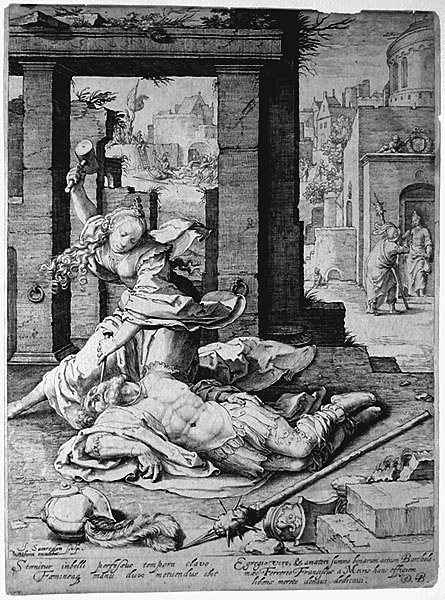
16 May, 2006
Two Things
1. I've had an apostrophe. I thought of a great name for my pub: 'The Axe and Tree: the public house of St. Boniface'. Did you know he's the patron saint of brewers? I thought it would be neat to have part of that passage from John (you know, where the axe is laid at the root of the tree?) done up over the doorway. Isn't it great?
2. Quote from Wendell Berry. He makes me feel quasi-normal:
'She would do a man's work when she needed to, but she lived and died without ever putting on a pair of pants. She wore dresses. Being a widow, she wore them black. Being a woman of her time, she wore them long. The girls of her day, I think, must have been like well-wrapped gifts, to be opened by their husbands on their wedding night, a complete surprise. "Well! What's this?"'
2. Quote from Wendell Berry. He makes me feel quasi-normal:
'She would do a man's work when she needed to, but she lived and died without ever putting on a pair of pants. She wore dresses. Being a widow, she wore them black. Being a woman of her time, she wore them long. The girls of her day, I think, must have been like well-wrapped gifts, to be opened by their husbands on their wedding night, a complete surprise. "Well! What's this?"'
11 May, 2006
Brave woman, that.
I've never heard anything like this before. I've heard the 'good stewardship' argument, but nothing this in-depth. And Mrs. Colvin is right: nowhere does God give mankind stewardship over mankind. Other than to command us to multiply and fill the earth, that is.
_____________
In other news, I'm reading Moll Flanders. She is, I think, what Mrs. Badgermum would call a 'shameless hussy'. I'm about sixty pages from the end, and so far: she's been married five times (once to her half-brother, accidently), a mistress twice, had 10 children (half survived childhood), and stolen enough to make a small fortune-- and she's only forty-five years old. The woman is incredible, in the original (Latin) sense of the word. On the other hand, I learned a new word for harlot: trull.
_____________
In other news, I'm reading Moll Flanders. She is, I think, what Mrs. Badgermum would call a 'shameless hussy'. I'm about sixty pages from the end, and so far: she's been married five times (once to her half-brother, accidently), a mistress twice, had 10 children (half survived childhood), and stolen enough to make a small fortune-- and she's only forty-five years old. The woman is incredible, in the original (Latin) sense of the word. On the other hand, I learned a new word for harlot: trull.
03 May, 2006
The English literature is sinking in...
I was just listening to an account of the life of Boniface (patron saint of brewers, by the way), and do you know what happened? I heard the lecturer say that Boniface refused his inheritance in order to become a monk and I thought,'He can't do that, he's the firstborn son!'
Ha! Take that, egalitarianism!
Ha! Take that, egalitarianism!
01 May, 2006
Books I've Read
So far this calendar year, I've read only 12 books. I am very disappointed, considering 1. that I didn't read any books in March (what was I thinking?), 2. that last year at this time I had read 30 books already, and 3. that the year before at this time I had read 22 books. I've got a lot of catching up to do.
Before I do that, though, I thought I'd post something interesting (to me, at least). So. Here's some book lists:
What I Read in April a.d. 2004
Alice's Adventures in Wonderland & Through the Looking Glass- Lewis Carroll
The Lord of the Flies- William Golding (this book was terrible)
The Legend of Sleepy Hollow, and other short stories- Washington Irving
Coming Up for Air- George Orwell
What I Read in April a.d. 2005
Short Stories- J.F. Powers (bad author; uninteresting stories)
Henry and the Great Society- H.L. Roush
The Golden Key- George MacDonald
Miniatures and Morals- Peter Leithart
The Vanishing American Outhouse- Ronald S. Barlow
Dutch Colors- Douglas Jones
Scottish Seas- Douglas Jones
Huguenot Gardens- Douglas Jones
Summary of Christian Doctrine- Louis Berkhof
Memoirs of a Geisha- Arthur Golden
River Town- Peter Hessler
The Legacy of Biblical Womanhood- Susan Hunt and Barbara Thompson
The Ragamuffin Gospel- Brennan Manning
Future Men- Douglas Wilson
And...
What I Read April a.d. 2006
Q's Legacy- Helene Hanff
The Sunday Philosophy Club- Alexander McCall Smith (all the rage, but not really a good story)
The No. 1 Ladies Detective Agency- Alexander McCall Smith (ditto)
Right Ho, Jeeves- P.G. Wodehouse
There. Now, to read.
Before I do that, though, I thought I'd post something interesting (to me, at least). So. Here's some book lists:
What I Read in April a.d. 2004
Alice's Adventures in Wonderland & Through the Looking Glass- Lewis Carroll
The Lord of the Flies- William Golding (this book was terrible)
The Legend of Sleepy Hollow, and other short stories- Washington Irving
Coming Up for Air- George Orwell
What I Read in April a.d. 2005
Short Stories- J.F. Powers (bad author; uninteresting stories)
Henry and the Great Society- H.L. Roush
The Golden Key- George MacDonald
Miniatures and Morals- Peter Leithart
The Vanishing American Outhouse- Ronald S. Barlow
Dutch Colors- Douglas Jones
Scottish Seas- Douglas Jones
Huguenot Gardens- Douglas Jones
Summary of Christian Doctrine- Louis Berkhof
Memoirs of a Geisha- Arthur Golden
River Town- Peter Hessler
The Legacy of Biblical Womanhood- Susan Hunt and Barbara Thompson
The Ragamuffin Gospel- Brennan Manning
Future Men- Douglas Wilson
And...
What I Read April a.d. 2006
Q's Legacy- Helene Hanff
The Sunday Philosophy Club- Alexander McCall Smith (all the rage, but not really a good story)
The No. 1 Ladies Detective Agency- Alexander McCall Smith (ditto)
Right Ho, Jeeves- P.G. Wodehouse
There. Now, to read.
25 April, 2006
Y'all will never believe what happened.
I was just driving along-- minding my own business-- when all of a sudden, someone pulled me over. Seriously. And then, she took some of my money. And she made me take some books. Really. It wasn't my fault.
I got R. L. Stevenson's The Black Arrow, and Betty Smith's A Tree Grows in Brooklyn (which is a book about a book lover, like me. Only slightly more depressing than my life). Hardbacks. Old-looking ones. They're great.
I can't believe that lady. The nerve! She knew I wasn't going to stop at her bookstore, because I don't really have the money to spend on books. And she made me take those. What is this world coming to, anyway?
I got R. L. Stevenson's The Black Arrow, and Betty Smith's A Tree Grows in Brooklyn (which is a book about a book lover, like me. Only slightly more depressing than my life). Hardbacks. Old-looking ones. They're great.
I can't believe that lady. The nerve! She knew I wasn't going to stop at her bookstore, because I don't really have the money to spend on books. And she made me take those. What is this world coming to, anyway?
24 April, 2006
What a funny man.
From Hilaire Belloc's Moral Alphabet:
W
My little victim, let me trouble you
To fix your active mind on W.
The Waterbeetle here shall teach
A sermon far beyond your reach:
He flabbergasts the Human Race
By gliding on the water's face
With ease, celerity, and grace;
But if he ever stopped to think
Of how he did it, he would sink.
MORAL
Don't ask Questions!
He also wrote several Cautionary Tales for Children. Here are a few titles:
Jim: Who Ran Away from His Nurse, and Was Eaten by a Lion
Henry King: Who Chewed Bits of String, and Was Early Cut Off in Dreadful Agonies
Matilda: Who Told Lies, and Was Burned to Death
Franklin Hyde: Who Caroused in the Dirt and Was Corrected by His Uncle
Godolphin Horne: Who Was Cursed with the Sin of Pride, and Became a Boot-Black
Perhaps my favourite is 'Maria: Who Made Faces and a Deplorable Marraige'.
See what I mean? What a funny man.
W
My little victim, let me trouble you
To fix your active mind on W.
The Waterbeetle here shall teach
A sermon far beyond your reach:
He flabbergasts the Human Race
By gliding on the water's face
With ease, celerity, and grace;
But if he ever stopped to think
Of how he did it, he would sink.
MORAL
Don't ask Questions!
He also wrote several Cautionary Tales for Children. Here are a few titles:
Jim: Who Ran Away from His Nurse, and Was Eaten by a Lion
Henry King: Who Chewed Bits of String, and Was Early Cut Off in Dreadful Agonies
Matilda: Who Told Lies, and Was Burned to Death
Franklin Hyde: Who Caroused in the Dirt and Was Corrected by His Uncle
Godolphin Horne: Who Was Cursed with the Sin of Pride, and Became a Boot-Black
Perhaps my favourite is 'Maria: Who Made Faces and a Deplorable Marraige'.
See what I mean? What a funny man.
20 April, 2006
This makes me laugh.
Maybe this is common knowledge, but I just found out. I thought I'd share the information, the insanity, and the overwhelming urge to snort. Evidently, tobacco companies are required to advertise against their own products. It's incredible, I know. But it's true. I saw a commercial on television urging kids not to smoke. I saw that it was put out by Phillip-Morris. 'That's odd,' I thought. 'Doesn't Phillip-Morris produce cigarettes?' I asked my parents and they told me that all tobacco companies must do this. I laughed. Surely not. Surely the government isn't so ridiculous as to order a company to sabotage it's own business.
Alas.
Alas.
17 April, 2006
16 April, 2006
13 April, 2006
Community: otherwise known as,'I can't believe I'm posting twice in one day!'
Rose and I have been talking quite a bit lately. We chat over g-mail nearly every day, I've seen her three times this week, and I'll see her again tonight. Also, the e-mails have been flying back and forth like you wouldn't believe. It's been pretty interesting to get her perspective on the things that have been happening in our church. She's always interested in hearing what I have to say, too, which is encouraging to me. One of the main topics of conversation has been community and the fact that churches in our town, especially ones that call themselves reformed, don't have any fellowship with each other. It's odd that those who are supposed to be known by their love for one another don't ever see each other.
As a result of this scarceness of community, Rose has been getting to know some of the ladies that attend Grace OPC, and she and Tony have been attending Grace's Wednesday night prayer meetings every week. We were discussing this, over e-mail, when she said something like,'Now you're in on my secret...' She mentioned that she didn't talk about this fellowship with anyone else because of the unpleasant reaction she expected. I think the session might not like it, because of past relationships that are now severed, so I'm inclined to agree with her, and not spread it around too much. Here's what I wrote back:
And now you're in on mine. :) I don't usually talk about such controversial topics with anyone but Kelly, Robert, the Cumbees, and the Stuarts. Now you and Tony know that I'm not really presbyterian...it's a good thing I know your secret-- now I don't have to kill you. I have a guarantee that you won't talk: I know what you do on Wednesday nights!!! Mwa ha ha ha ha! ;)
Seriously, I don't think there's anything wrong with having a group of friends that go to another church; nor is it wrong to attend that church's activities. Especially if the church you attend is so young that there isn't a good, deep community yet. Mom said it's kind of like how babies learn; they either learn to walk or talk, but not both at the same time. They only have the energy for one thing, and she thinks that's the way our church is functioning now. It'll be a while before we're a body of friends AND a body of saints. So, I'm all for extending our community to include Grace. And it sounds like they're interested in befriending us, too.
But, you're right. There's a reason I don't tell people certain of my beliefs: it makes them nervous. They've never thought those things out, so all I get is a gut reaction...and it's usually negative. So, no one knows what I really think, which is odd; it seems like everyone would, the way they talk about me being so opinionated. I'm not sure, still, where to draw the line between being secretive, and being argumentative. I used to lean towards argumentative. Now I think I lean more towards secretive. It shows itself especially with my parents. It's not that I hide my thoughts from them, but I certainly don't pick fights. And when they ask for my opinion, I tell them, doing my best to be tactful. So, sometimes I feel like I'm being deceptive, and other times I feel like I'm being quarrelsome.
_________________
What began as a mere agreement became a short essay. That's been happening a lot lately. So, here's what I want to know: does anyone have any idea where that line between deception and thunder-puppyness is? And what can we do when we have a church that doesn't fellowship, within or without?
As a result of this scarceness of community, Rose has been getting to know some of the ladies that attend Grace OPC, and she and Tony have been attending Grace's Wednesday night prayer meetings every week. We were discussing this, over e-mail, when she said something like,'Now you're in on my secret...' She mentioned that she didn't talk about this fellowship with anyone else because of the unpleasant reaction she expected. I think the session might not like it, because of past relationships that are now severed, so I'm inclined to agree with her, and not spread it around too much. Here's what I wrote back:
And now you're in on mine. :) I don't usually talk about such controversial topics with anyone but Kelly, Robert, the Cumbees, and the Stuarts. Now you and Tony know that I'm not really presbyterian...it's a good thing I know your secret-- now I don't have to kill you. I have a guarantee that you won't talk: I know what you do on Wednesday nights!!! Mwa ha ha ha ha! ;)
Seriously, I don't think there's anything wrong with having a group of friends that go to another church; nor is it wrong to attend that church's activities. Especially if the church you attend is so young that there isn't a good, deep community yet. Mom said it's kind of like how babies learn; they either learn to walk or talk, but not both at the same time. They only have the energy for one thing, and she thinks that's the way our church is functioning now. It'll be a while before we're a body of friends AND a body of saints. So, I'm all for extending our community to include Grace. And it sounds like they're interested in befriending us, too.
But, you're right. There's a reason I don't tell people certain of my beliefs: it makes them nervous. They've never thought those things out, so all I get is a gut reaction...and it's usually negative. So, no one knows what I really think, which is odd; it seems like everyone would, the way they talk about me being so opinionated. I'm not sure, still, where to draw the line between being secretive, and being argumentative. I used to lean towards argumentative. Now I think I lean more towards secretive. It shows itself especially with my parents. It's not that I hide my thoughts from them, but I certainly don't pick fights. And when they ask for my opinion, I tell them, doing my best to be tactful. So, sometimes I feel like I'm being deceptive, and other times I feel like I'm being quarrelsome.
_________________
What began as a mere agreement became a short essay. That's been happening a lot lately. So, here's what I want to know: does anyone have any idea where that line between deception and thunder-puppyness is? And what can we do when we have a church that doesn't fellowship, within or without?
Attention Deficit Hyperness Disorder, as applies to books
I've made a couple of changes to my book list; it wasn't quite up-to-date. I came back from my visit in Virginia with a handful of books to read, and I haven't finished any of them yet. I have such a hard time concentrating on a book once I've started it. That is, as my friend Kelly says, I have 'book ADHD'. I can remember where I am in 40 books at once; I've done it before. But I can't confine myself to reading one book at a time. I start one, and then, I see another that looks interesting, and so I start that one too. And pretty soon, I have a whole shelf full of books that I'm reading. Then, the more 'boring' books, or the slower ones, get pushed down the list until I haven't picked them up in a few months, or maybe a year. Like Moby Dick. I pick that up about once a year, generally in the fall; I read a chapter, and then I put it down again until the next fall. I'm afraid that if this goes on, I will never finish it.
On the other hand, when I got back I picked up Lorna Doone and haven't put it down since. I love Blackmore's writing style, I love the hero, I love the countryside setting, I love to hate the Doones, I love and pity Lorna; in short, I love everything about the book. I will be sad when I finish it. I'll probably read it again, like Narnia, the Lord of the Rings, and Lewis' space trilogy.
Why does this happen? How can I pick up Austen one year and hate it; and the next year, pick up the same book and love it? Am I really that fickle?!
I've tried several times, without much long-term success, to tame this habit of mine. One week I picked up five books that I needed to read and had already started, but that had been sitting, forlorn, for a month or so. I decided to read only those books for that week. I read one of them only at lunch, one only in the afternoons, one just after supper, and one right before bed. The fifth I carried around with me everywhere and read whenever I had a chance. I read at least a chapter from each every day. This was a good plan. What happened, you ask? I don't know. I finished those books and then gave up my plan. I guess I just don't have enough stick-to-itiveness.
So the funny thing is, when I finish a book I write down the title and the date finished. But really, the date finished has nothing to do with anything, because I could have read the entire book but one chapter last year; and just this week decided to finish that last chapter. So when I tell people what I've finished reading lately, they're always really impressed. But they shouldn't be, because I haven't actually been reading those books lately. I only happened to read that last little bit just before they asked. I've thought about explaining all of this to those oh-so-impressed people, so as to set them straight, and not take too much credit, but I decided that it's too complicated and they would only nod and ignore what I was saying, anyway.
Now, however, I feel a bit better. I've explained to at least two people (the only two that read this) how very, very devious I am. ;)
On the other hand, when I got back I picked up Lorna Doone and haven't put it down since. I love Blackmore's writing style, I love the hero, I love the countryside setting, I love to hate the Doones, I love and pity Lorna; in short, I love everything about the book. I will be sad when I finish it. I'll probably read it again, like Narnia, the Lord of the Rings, and Lewis' space trilogy.
Why does this happen? How can I pick up Austen one year and hate it; and the next year, pick up the same book and love it? Am I really that fickle?!
I've tried several times, without much long-term success, to tame this habit of mine. One week I picked up five books that I needed to read and had already started, but that had been sitting, forlorn, for a month or so. I decided to read only those books for that week. I read one of them only at lunch, one only in the afternoons, one just after supper, and one right before bed. The fifth I carried around with me everywhere and read whenever I had a chance. I read at least a chapter from each every day. This was a good plan. What happened, you ask? I don't know. I finished those books and then gave up my plan. I guess I just don't have enough stick-to-itiveness.
So the funny thing is, when I finish a book I write down the title and the date finished. But really, the date finished has nothing to do with anything, because I could have read the entire book but one chapter last year; and just this week decided to finish that last chapter. So when I tell people what I've finished reading lately, they're always really impressed. But they shouldn't be, because I haven't actually been reading those books lately. I only happened to read that last little bit just before they asked. I've thought about explaining all of this to those oh-so-impressed people, so as to set them straight, and not take too much credit, but I decided that it's too complicated and they would only nod and ignore what I was saying, anyway.
Now, however, I feel a bit better. I've explained to at least two people (the only two that read this) how very, very devious I am. ;)
10 April, 2006
How do you spell 'Berean', anyway?
I've had several interesting conversations over the past couple of days; one taking place yesterday morning, rather unexpectedly. My friend Rose asked me a complicated question and even though I tried to answer concisely, thus keeping the controversy to a minimum, it blew up in my face and I ended up explaining a lot more than I wanted.* Also, I got Credenda/Agenda's special issue on 'That Wonderful Cup', which is entirely about paedocommunion, so controversy has been on my mind lately.
Something I've noticed, re:controversy, is that the Book of Church Order (cue impressive music) has nearly replaced the Bible as the standard for presbyterian doctrine. For instance, what was all that mess in Virginia about? The BCO. And what do I hear when I ask questions of people at my church? Whatever the BCO says. It's automatic--there isn't any question of whether or not it complies with Scripture. I think this is tied in with my previous questions; if we have a church that doesn't understand Biblical government and authority, and they aren't teaching people wisdom and discernment, but only to blindly trust, then the logical result is rote recital of the only standard that is known and Bereanism is thrown to the wayside. This is also why we have 'troublemakers'-- we're those people that ask uncomfortable questions. 'Yes, but...what does the Bible say?'
The misunderstanding of these things contributes to the problem with the church today: paedocommunion, eldership, the BCO, authority, membership, and baptism. I'm not entirely sure how exactly they fit together, but I think I'm well on my way to figuring it out.
Here's an excerpt from a post by Mr. Colvin (Dr.?) that explains a bit of the puzzle:
'Pastors must come to realize that they do not have the right, let alone the duty, of examining the infants of believers to admit them to the Supper, anymore than they have the right to refuse to baptize the infants of believers. If we only confront such pastors with lots of cute communing babies -- like so many Hallmark cards or advertisements for Pampers -- then we are not challenging them at the crux of the issue: it is about their wrongful usurpation of power and unbiblical judgment of others, not about the precociousness of any toddlers.'
____________
*NB- I try not to discuss these sorts of things until I feel like I can adequately explain and defend my opinions. I didn't think I could, but it turned out pretty well.
Something I've noticed, re:controversy, is that the Book of Church Order (cue impressive music) has nearly replaced the Bible as the standard for presbyterian doctrine. For instance, what was all that mess in Virginia about? The BCO. And what do I hear when I ask questions of people at my church? Whatever the BCO says. It's automatic--there isn't any question of whether or not it complies with Scripture. I think this is tied in with my previous questions; if we have a church that doesn't understand Biblical government and authority, and they aren't teaching people wisdom and discernment, but only to blindly trust, then the logical result is rote recital of the only standard that is known and Bereanism is thrown to the wayside. This is also why we have 'troublemakers'-- we're those people that ask uncomfortable questions. 'Yes, but...what does the Bible say?'
The misunderstanding of these things contributes to the problem with the church today: paedocommunion, eldership, the BCO, authority, membership, and baptism. I'm not entirely sure how exactly they fit together, but I think I'm well on my way to figuring it out.
Here's an excerpt from a post by Mr. Colvin (Dr.?) that explains a bit of the puzzle:
'Pastors must come to realize that they do not have the right, let alone the duty, of examining the infants of believers to admit them to the Supper, anymore than they have the right to refuse to baptize the infants of believers. If we only confront such pastors with lots of cute communing babies -- like so many Hallmark cards or advertisements for Pampers -- then we are not challenging them at the crux of the issue: it is about their wrongful usurpation of power and unbiblical judgment of others, not about the precociousness of any toddlers.'
____________
*NB- I try not to discuss these sorts of things until I feel like I can adequately explain and defend my opinions. I didn't think I could, but it turned out pretty well.
07 April, 2006
Fun with verbs!
absquatulate: to flee, make off; abscond.
defenestrate: to throw out of a window.
lapidate: to stone.
maffick: to rejoice with an extravagant and boisterous public celebration.
spanghew: to cause a frog or toad to fly up in the air.
whinge: to complain fretfully, to whine.
Now...how to incorporate these into my everyday conversation?
-------
Also, more silliness can be found here. My favourite is 'Swedish Chef'. Bork bork bork!
defenestrate: to throw out of a window.
lapidate: to stone.
maffick: to rejoice with an extravagant and boisterous public celebration.
spanghew: to cause a frog or toad to fly up in the air.
whinge: to complain fretfully, to whine.
Now...how to incorporate these into my everyday conversation?
-------
Also, more silliness can be found here. My favourite is 'Swedish Chef'. Bork bork bork!
I delight in C.S. Lewis.
Perelandra
[Page 214 & 17: The eldila speak...]
It is loaded with justice as a tree bows down with fruit. All is righteousness and there is no equality. Not as when stones lie side by side, but as when stones support and are supported in an arch, such is His order; rule and obedience, begetting and bearing, heat glancing down, life growing up. Blessed be He!
He has immeasurable use for each thing that is made, that His love and splendour may flow forth like a strong river which has need of a great watercourse and fills alike the deep pools and the little crannies, that are filled equally and remain unequal; and when it has filled them brim full it flows over and makes new channels. We also have need beyond measure of all that He has made. Love me, my brothers, for I am infinitely necessary to you and for your delight I was made. Blessed be He!
He has no need at all of anything that is made. An eldil is not more needful to Him than a grain of the Dust: a peopled world no more needful than a world that is empty: but all needless alike, and what all add to Him is nothing. We also have no need of anything that is made. Love me, my brothers, for I am infinitely superfluous, and your love shall be like His, born neither of your need nor of my deserving, but a plain bounty. Blessed be He!
_____________
[Page 193: Jane misunderstands MacPhee's discourse on the 'impartial investigation' of all that's been happening...]
'There's such a thing as loyalty,' said Jane. MacPhee, who had been carefully shutting up the snuff-box, suddenly looked up with a hundred covenanters in his eyes.
'There is, Ma'am,' he said. 'As you get older you will learn that it is a virtue too important to be lavished on individual personalities.'
___________
[Page 303: Ivy Maggs speaks to Jane...]
I remember one day-- it was before you came-- Mother Dimble was saying something to the Doctor; and there he was sitting reading something, you know the way he does, with his fingers under some of the pages and a pencil in his hand-- not the way you or I'd read-- and he just said, 'Yes, dear,' and we both of us knew he hadn't been listening. And I said, 'There you are, Mother Dimble,' said I, 'that's how they treat us once they're married. They don't even listen to what we say,' I said. And do you know what she said? 'Ivy Maggs,' said she, 'did it ever come into your mind to ask whether anyone could listen to all we say?' Those were her very words. Of course I wasn't going to give in to it, not before him, so I said, 'Yes, they could.' But it was a fair knock-out. You know how often I've been talking to my husband for a long time and he's looked up and asked me what I've been saying and, do you know? I haven't been able to remember myself!
_______
[Page 214 & 17: The eldila speak...]
It is loaded with justice as a tree bows down with fruit. All is righteousness and there is no equality. Not as when stones lie side by side, but as when stones support and are supported in an arch, such is His order; rule and obedience, begetting and bearing, heat glancing down, life growing up. Blessed be He!
He has immeasurable use for each thing that is made, that His love and splendour may flow forth like a strong river which has need of a great watercourse and fills alike the deep pools and the little crannies, that are filled equally and remain unequal; and when it has filled them brim full it flows over and makes new channels. We also have need beyond measure of all that He has made. Love me, my brothers, for I am infinitely necessary to you and for your delight I was made. Blessed be He!
He has no need at all of anything that is made. An eldil is not more needful to Him than a grain of the Dust: a peopled world no more needful than a world that is empty: but all needless alike, and what all add to Him is nothing. We also have no need of anything that is made. Love me, my brothers, for I am infinitely superfluous, and your love shall be like His, born neither of your need nor of my deserving, but a plain bounty. Blessed be He!
_____________
That Hideous Strength
[Page 193: Jane misunderstands MacPhee's discourse on the 'impartial investigation' of all that's been happening...]
'There's such a thing as loyalty,' said Jane. MacPhee, who had been carefully shutting up the snuff-box, suddenly looked up with a hundred covenanters in his eyes.
'There is, Ma'am,' he said. 'As you get older you will learn that it is a virtue too important to be lavished on individual personalities.'
___________
[Page 303: Ivy Maggs speaks to Jane...]
I remember one day-- it was before you came-- Mother Dimble was saying something to the Doctor; and there he was sitting reading something, you know the way he does, with his fingers under some of the pages and a pencil in his hand-- not the way you or I'd read-- and he just said, 'Yes, dear,' and we both of us knew he hadn't been listening. And I said, 'There you are, Mother Dimble,' said I, 'that's how they treat us once they're married. They don't even listen to what we say,' I said. And do you know what she said? 'Ivy Maggs,' said she, 'did it ever come into your mind to ask whether anyone could listen to all we say?' Those were her very words. Of course I wasn't going to give in to it, not before him, so I said, 'Yes, they could.' But it was a fair knock-out. You know how often I've been talking to my husband for a long time and he's looked up and asked me what I've been saying and, do you know? I haven't been able to remember myself!
_______
Subscribe to:
Comments (Atom)
